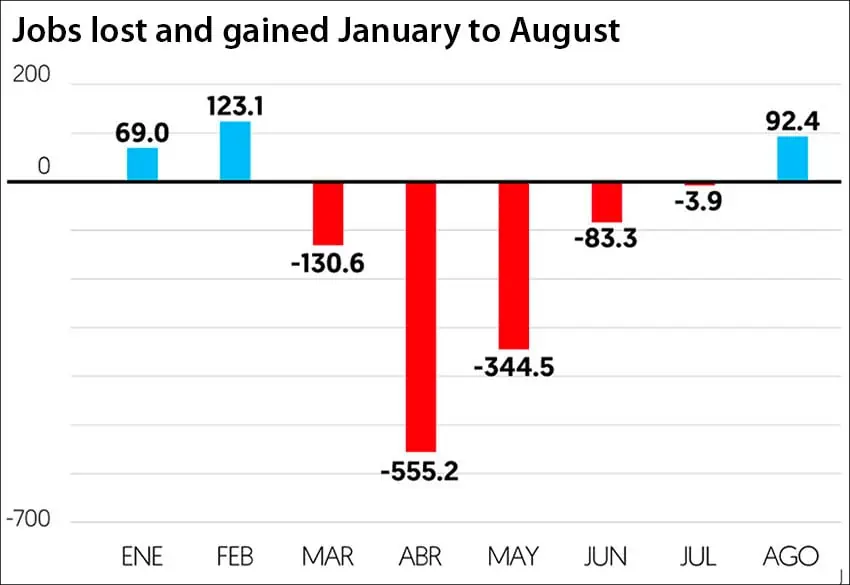
The labor market added 92,390 formal sector jobs in August, according to data from the Mexican Social Security Institute (IMSS), the first increase in employment figures since February.
The positive job numbers come after five consecutive months of losses. A total of 1,117,584 formal sector positions were lost between March and July as the coronavirus pandemic and associated restrictions took a heavy toll on the economy.
While the news that jobs were created in August is undoubtedly encouraging, the number of positions added only represents 8.2% of those lost in the previous five months.
Another sobering statistic is that only just over half of the new jobs are permanent positions. According to IMSS, 51.7% of the jobs created in August are permanent; the rest are temporary.
Nuevo León led the country for new jobs during the month, with 16,400 positions created in the northern border state. Jalisco ranked second with 15,900 new jobs followed by Chihuahua, where 8,400 positions were created.
Some states were unable to buck the trend in August and continued shedding formal sector jobs. Mexico City recorded the highest number of losses, shedding 5,465 positions.
Just over 2,000 jobs disappeared in Chiapas, Nayarit lost more than 1,600 and almost 1,100 workers in Sonora were laid off.

Compared to the end of August 2019, there were 833,100 fewer people employed in the formal sector across the country at the end of last month.
In percentage terms, the annual contraction in formal sector jobs was 4.1%. The business services and construction sectors recorded the biggest declines, with employment falling 9.2% and 9.1%, respectively.
Among the 32 states, Quintana Roo suffered the biggest annual decline with job numbers down 24.4% compared to August 2019. Baja California Sur recorded the second biggest decline, shedding 9.9% of formal sector jobs in the 12-month period to the end of August.
Both states are heavily dependent on tourism, a sector that has been decimated by the coronavirus crisis and which is expected to take a long time to recover.

Tabasco and Baja California are the only states where there were more people employed in the formal sector at the end of August than at the same time last year. Jobs in those two states increased by 2.1% and 1.2%, respectively.
At the end of August, just under 19.6 million people were employed in the formal sector and insured by IMSS, data shows.
While there is still a long way to go to recover all the jobs that have been lost, President López Obrador was upbeat on Sunday, highlighting that new positions have also been added in the first half of September
Speaking while inspecting the progress of work to extend line 12 of the Metro in Mexico City, the president said that the jobs recovery over the past 1 1/2 months can be attributed to the reopening of the economy, although many businesses are operating at reduced capacity.
“We’re making progress in confronting the pandemic and we’re also making progress in confronting the economic crisis. We’re not losing jobs anymore; let’s not forget that we lost jobs in April, May, June and July [but] in August and up to now in September we’ve recovered about 120,000 jobs,” López Obrador said.
“In other words, the economy is improving and we’re heading towards normality,” he added.
Andrés Peñaloza, president of the National Minimum Wage Commission, said in an interview that it is probable that employment will continue to grow this month and next because consumption tends to increase as the end of the year approaches.
“There will be a significant increase [in jobs] in September and October,” he predicted.
Still, the economy is predicted to suffer its worst contraction this year since the Great Depression of the 1930s. The central bank revised downwards its 2020 forecast at the end of last month, predicting that GDP could decline 12.8% in a worst case scenario.
López Obrador has asserted that the economy will bounce back quickly, stating in his annual address to the nation on September 1 that a V-shaped recovery is already underway.
But many analysts believe that the economy will recover only very slowly, especially considering that government support for business amid the coronavirus-induced downturn has been extremely limited.
Source: El Financiero (sp)