The government revealed a three-phase plan Wednesday for the eventual lifting of coronavirus restrictions and a color-coded “stoplight” system to determine each state’s readiness to return to what is being called a “new normal.”
Phase one begins on May 18, when 269 coronavirus-free municipalities across 15 states will be allowed to reopen with some restrictions.
During phase two, which also begins May 18 and ends May 31, the country will begin preparing for national social distancing measures to be lifted starting June 1 by training businesses and their employees in sanitary measures.
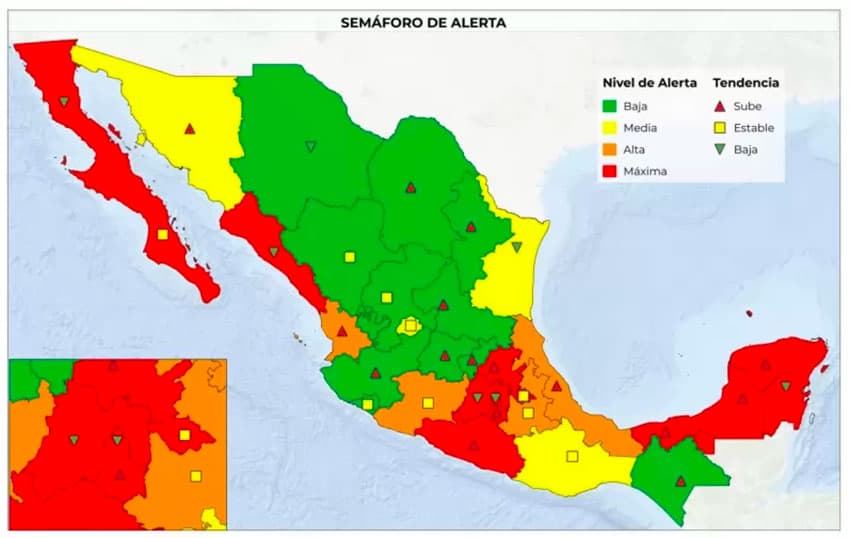
June marks the beginning of phase three, in which the government will assess each state’s readiness to reopen through a color-coded mapping system which will determine which restrictions are lifted and when.
“A large part of the country has no cases, which enables us to suspend national measures in favor of targeted ones,” López-Gatell explained of the lifting of national restrictions for state-by-state measures next month.
The color-coded map will show how the pandemic is progressing in different regions of the country.
States are assigned a color as well as an upward triangle if the number of cases is on the rise, a square if the number of cases is holding steady and a downward triangle if the number of cases is decreasing.

In states coded red, Economy Minister Graciela Márquez explained Wednesday morning, only essential activities will be allowed. The General Health Council announced Tuesday that this category will now include the mining, construction and automotive industries.
In orange-level states, nonessential activities may resume but at a reduced level. Public spaces can also be opened in a limited manner. Citizens who are considered particularly vulnerable to the coronavirus, the elderly and those with chronic underlying conditions, may return to work. However, accommodations will have to be made, including providing them an isolated space to eat, and possibly shortening their workday.
When a state passes into the yellow phase, all essential and nonessential activities can resume without any kind of restriction. Public spaces can open with fewer restrictions and restaurants, churches, museums and theaters may reopen but at a reduced level. Vulnerable populations can also begin to ease up on precautions.
And finally, when a state is coded green, students can return to school and all restrictions will be lifted, although sanitary measures should continue in businesses and public spaces, and those particularly vulnerable to the virus should continue to take precautions.
As of Tuesday, Mexico had 38,324 confirmed cases of the coronavirus.
Source: El Financiero (sp), Reforma (sp), Financial Times (en)