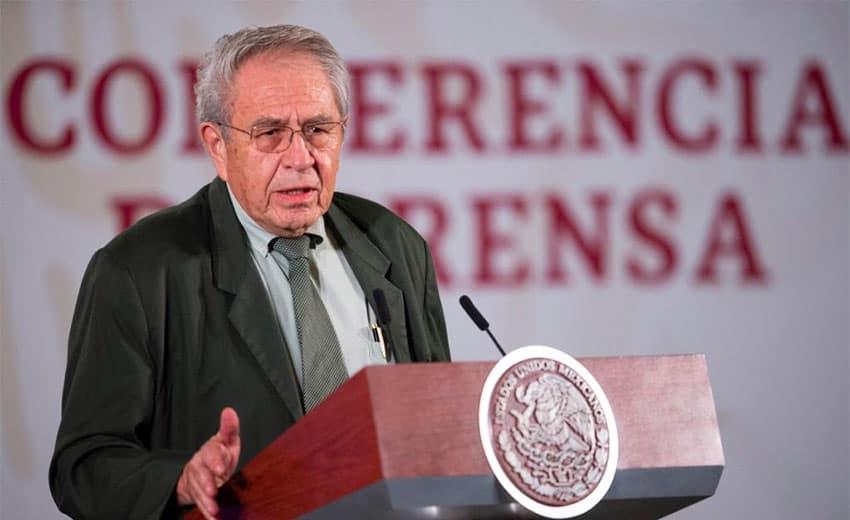
Mexico has a shortage of 200,000 doctors and 300,000 nurses, Health Minister Jorge Alcocer told reporters on Tuesday.
Speaking at President López Obrador’s regular news conference, Alcocer said that the public health system needs an additional 123,000 general physicians and approximately 76,000 specialists.
After leaving the National Palace in Mexico City, the health minister said that the system also needs at least 300,000 additional nurses.
While he didn’t specify a timeframe within which authorities hoped to recruit the half a million extra medical personnel required, Alcocer said that there is an immediate need to employ more healthcare workers to confront phase 3 of the coronavirus outbreak during which cases are expected to rise rapidly.
The Health Ministry launched a recruitment drive on Saturday that is seeking to find 12,300 nurses and 6,600 doctors, and in just a few days thousands of applications have poured in, Alcocer said.
He told reporters at the news conference that 6,548 doctors, including 204 specialists in fields including anesthesiology and respiratory diseases, and 12,605 nurses have already been recruited.
The additional personnel will help Mexico “to get through” this epidemic “in a matter of weeks, or maybe months” and continue to provide invaluable services in the future, Alcocer said.

The army is also seeking to bolster its medical capacity to respond to the novel coronavirus, which had infected more than 1.4 million people around the world as of Wednesday morning and claimed the lives of more than 83,000.
There has been a strong response to the Defense Ministry’s call for applications from doctors, nurses and administrative staff but many candidates have hit a snag: they are unable to obtain police clearance certificates because government offices are closed due to the health emergency declaration.
Mercedes Herrera, a retired nurse seeking to re-enter the workforce, told the newspaper Milenio outside military facilities in Mexico City that the job advertisement to which she was responding didn’t specify that applicants needed a police certificate showing that they don’t have a criminal record.
“It wasn’t until we arrived here that we found out that they’re asking for it and now everything’s closed; where are we going to get it?” she said.
“Because of this requirement a lot of people are not going to get jobs,” Herrera added.
Another applicant for a nursing position, 25-year-old Karla Rivera, criticized the fact that the army is only offering positions in military-run medical facilities for a period of 150 days.
“Why is it only temporary? … The health sector always needs more nurses, more doctors,” she said, charging that permanent positions should be made available.
Rivera also said that the salaries on offer – 35,000 pesos (US $1,500) per month for specialist doctors, 23,000 pesos for general physicians and between 18,000 and 21,000 pesos for nurses – are too low considering the risks to which medical personnel are exposed.
However, another job hopeful said that his motivation was not money but to help his country in a time of need.
“Mexico needs us … A lot of us want to help … we’re only in the early stage of what is going to happen,” said Édgar Hernández, one of thousands of volunteers who swung into action after powerful earthquakes rocked the capital in 1985 and 2017.
Source: Expansión Política (sp), Milenio (sp)