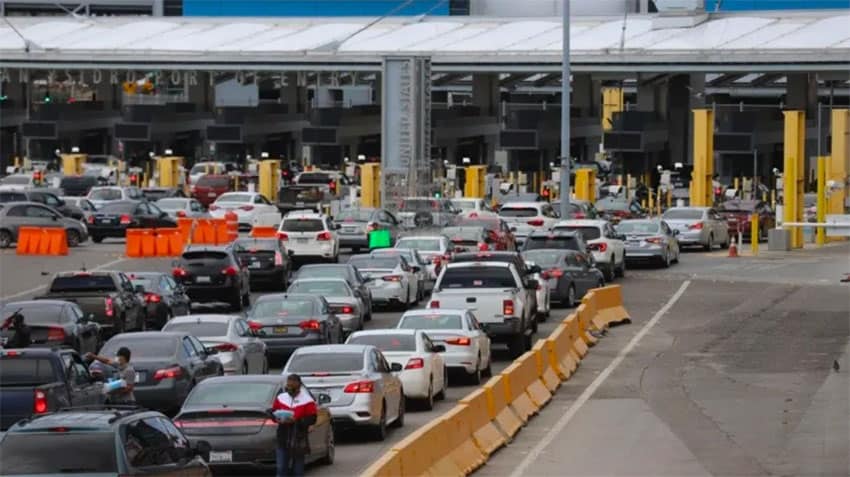
Foreign Minister Marcelo Ebrard failed to give a definitive answer to a question Thursday about whether Mexico would enforce the ban on nonessential land travel across the United States border more strictly.
Although a ban on nonessential land travel across the Mexico-U.S. border in both directions has been in place since March, a reporter who works for a media group in northern Mexico told Ebrard that Mexican border authorities have allowed “crossings of all kinds.”
Shaila Rosagel asked during Thursday’s presidential press conference how likely it was that Mexico would stop nonessential travel.
In his initial response, Ebrard said the government doesn’t see any change in the short term to the prohibition on nonessential travel but didn’t comment on the assertion that Mexico is allowing people into the country for nonessential purposes.
That prompted Rosagel to ask: “But will Mexico be stricter on crossings?”
“There are different ways of looking at it,” the foreign minister responded.
“Mexico is not going to opt for an imperative closure because that would have a lot of [negative] consequences. What does an imperative closure mean? Well, you can’t come in, … that would paralyze activity on the border and … the damage … could be enormous,” Ebrard said.

“So, yes recommendations are made; yes the position that all nonessential activities cannot be carried out is maintained but we don’t foresee a complete closure of activities because the impact could be very grave.”
Despite the ban on nonessential travel, there have been numerous reports of United States citizens entering Mexico by land for tourism purposes. The Associated Press said in July that while the United States was blocking nonessential cross-border travel, by and large Mexico wasn’t doing the same.
In early July, residents of the border community of Sonoyta, Sonora, briefly raised an impromptu blockade of the road leading from the border crossing at Lukeville, Arizona, into their city in a bid to prevent visitors from increasing the number of Covid-19 cases.
The road is the quickest way to travel from Arizona to Puerto Peñasco, a resort city on the Gulf of California that is popular with United States tourists. A week before the blockade was erected, Puerto Peñasco Mayor Kiko Munro said the city was happy to welcome back tourists.
The Chihuahua Congress last week unanimously approved a proposal to ask the federal government to enforce the land border closure after the state declared there was no enforcement.
Some people in Chihuahua, where the risk of coronavirus infection is currently red light “maximum” according to the federal government’s stoplight system, blame the recent spike in cases in the on travel – both essential and nonessential – from the United States, which has been hit harder by the pandemic than any other country in the world.
“The free transit of U.S. citizens [over the border] implies a great risk to the bordering cities in our state,” said Alejandro Gloria González, a Chihuahua deputy who put forward the proposal asking the federal government to enforce the ban on nonessential travel.
VICE News reported that the federal government has yet to respond publicly about border enforcement, and noted that “as cases continue to rise on the southern side of the U.S. border, it may soon be harder for Americans to cross with the same ease of the last few months.”
Under the agreement struck between Mexico and the United States in March, cross-border travel is limited to that related to essential work, education, trade, military operations or medical reasons.
Mexico News Daily