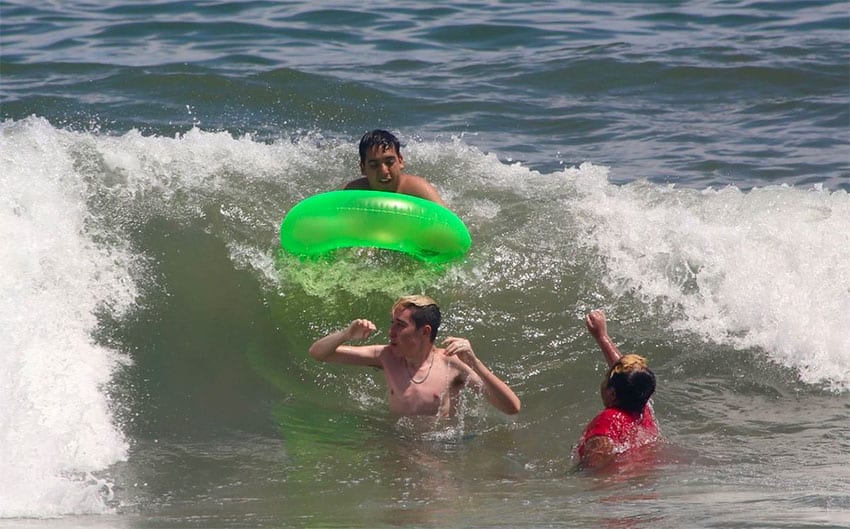
A “new normal” is coming soon to Mexico’s beaches courtesy of the coronavirus pandemic.
By next week at the latest, federal authorities will publish new rules on the use of beaches aimed at reducing the risk of the coronavirus spreading among people enjoying the sand and surf along Mexico’s extensive coastline.
State and municipal governments will be required to enforce the rules for the foreseeable future regardless of the local coronavirus situation.
The director of Zofematac, the federal office of maritime land zones and coastal environments, told the newspaper Milenio that a new beach use agreement will be published shortly.
Rodrigo Hernández Aguilar said the emphasis will be on social distancing among beachgoers – people shouldn’t come within four meters of others while on the sand or in the water.
He said people will not be required to wear face masks while they’re on the sand or in the water but they will have to wear them at beach entry points and in any common areas such as public washrooms.
“The use of face masks is mandated to arrive at the beach because there could be crowds when you’re entering the beach, you might be leaving a hotel where there are people or traveling on public transit. That’s why you use [a face mask] when you arrive and go onto the beach and also when you leave. Once you’re on the beach you don’t need to use it,” Hernández said.

He said that authorities decided not to make face masks mandatory on beaches because there is scientific evidence that salty water, sunlight and high temperatures “are favorable for the inactivation of pathogenic agents.”
The new beach rules will establish a limit of 40 people per 1,000 square meters of beach space. On beaches that are part of hotel precincts, staff will be required to disinfect hammocks and deck chairs after beachgoers vacate them, Hernández said.
Beachgoers will be required to place towels over the latter before they use them, he added.
Hernández said that all group recreational and sporting activities will be banned on beaches and that only 15 people will be allowed in the water at the same time. People should visit the beach on their own, with their partner or in small family units, not large groups, he said.
The Zofematac chief also said that under the new agreement, municipal governments will be able to take bookings from people who wish to go to the beach. Hernández added that beachgoers who flout the new regulations could be fined or even arrested.
To draw up the new rules, authorities looked at what their counterparts in four European countries have done, he said.
“We gave ourselves the task of studying what France, Spain, Italy and Greece did, which were the most advanced [countries] … in separating [people on] beaches.”
Source: Milenio (sp)