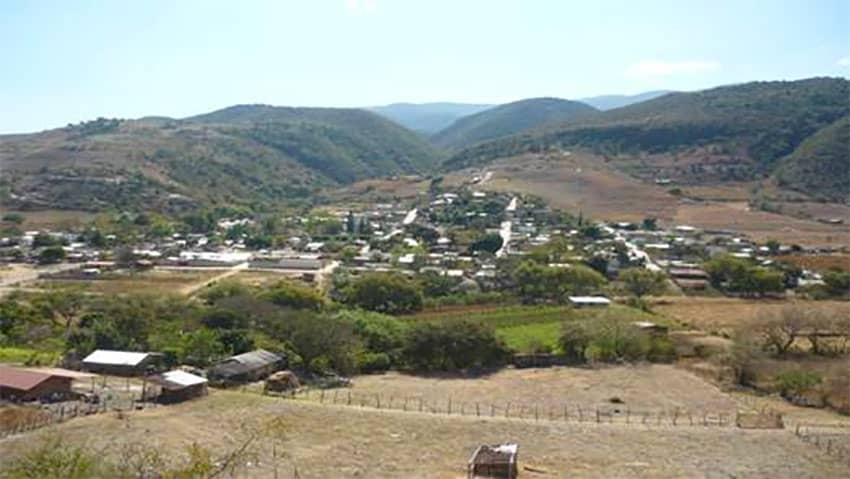
More than 2,000 indigenous Nahua children from some 18 primary schools in the municipalities of Atlixtac and Chilapa de Álvarez, Guerrero, were unable to start classes with the rest of the country on Monday because they lack internet and televisions.
It’s a common refrain as unequal access to technology accentuated by poverty brings out the flaws in distance education. Those who are disadvantaged may not receive an education until the coronavirus pandemic subsides.
On Monday morning Antonio Aranda Pinzón, principal of the Adolfo López Mateos bilingual primary school in the town of Mexcaltepec, one of the few towns in the Montaña Alta that sometimes has television reception, called an assembly.
Aranda placed an old tube television set in the center of the schoolyard and switched it on but was unable to pick up the educational programming or any of the stations broadcasting the Ministry of Education’s “Learn at Home II” curriculum.
In towns across the state’s Sierra, Montaña Alta and Baja and Costa Chica regions children are being prevented from learning, said José Manuel Venancio Santiago of Ceteg, the state teachers union.
And it’s the poor who are disproportionately affected.
“There are towns where they do not even have electricity, and those who have money can pay for the SKY service to watch private television channels, but those who do not, they cannot do anything,” he said. “How can a child learn to read on television?”

The Ministry of Education’s distance learning program is, in his opinion, “simply not viable.”
That’s proving to be the case in Amojileca, a town of about 1,000 residents located only 20 minutes from the capital, Chilpancingo.
Television reception is spotty at best, especially in the rainy season, and residents have asked Governor Héctor Astudillo Flores for community internet but to no avail.
In some areas of town residents can catch a signal, but to do so they must purchase a Wi-Fi card, which costs 20 pesos per day.
Erika Álvarez Ramos, a single mother of two school-aged children, makes and sells tortillas for a living and spending 200 pesos (US $9.11) a week so her children can learn is a financial impossibility.
And the logistics of distance learning are also hard for her to grasp even on a good day with TV reception, which she is lucky to have.
“I have to leave them at my house and turn on the television so they can take their classes while I go to work,” she said.
Distance learning means her children will be home unsupervised. It also means they will miss out on the free school lunch.
Whether the town’s 500 or so students will be able to attend class this year is uncertain, in a situation that is repeating itself across the state.
Source: La Jornada (sp)