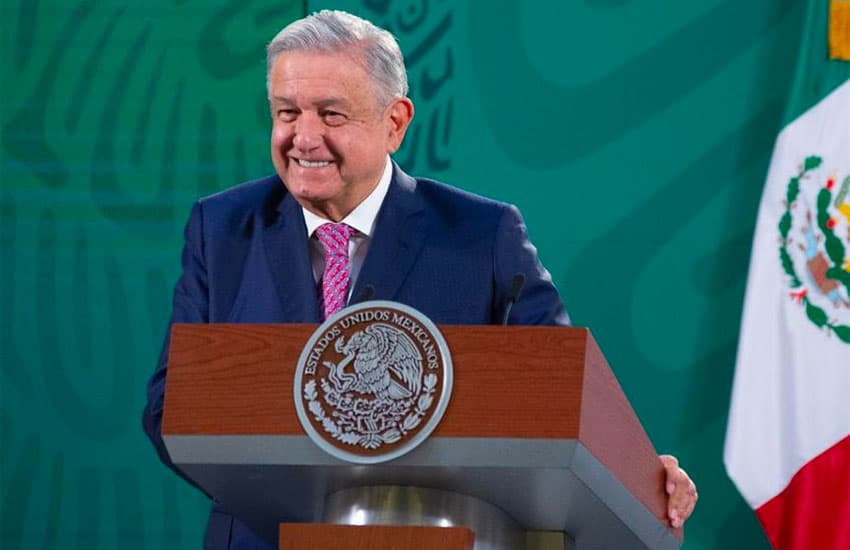
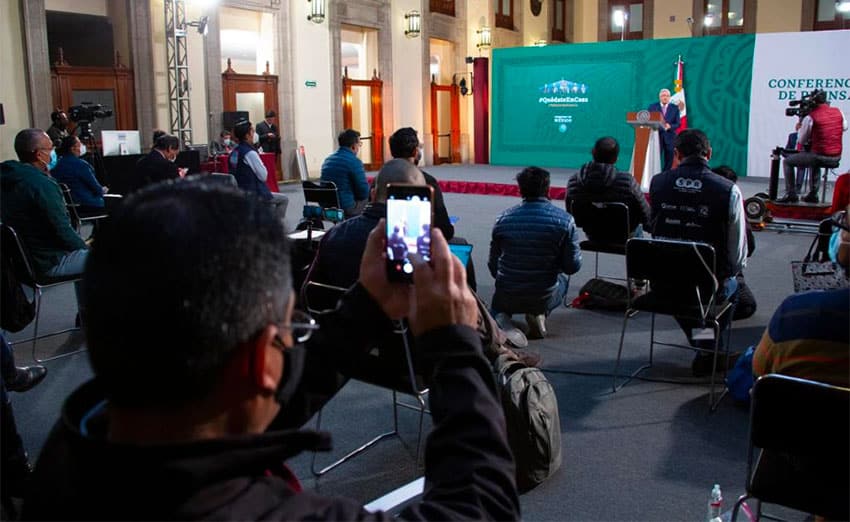
Two weeks after he announced he had tested positive for Covid-19, President López Obrador returned Monday to his favored position at the front and center of Mexican political life, appearing at the National Palace for his regular morning press conference.
“We’re back on our feet and fighting,” the unmasked president told reporters after thanking the foreigners and “all the Mexicans, men and women, who were concerned about my disease, my Covid infection.”
“We’re going to continue the transformation. It’s fundamental for Mexico to put an end to corruption so that the country is moralized and we can live with well-being and happiness,” López Obrador said.
The president, who was replaced by Interior Minister Olga Sánchez at the morning news conferences, noted that Health Minister Jorge Alcocer led a medical team that monitored his health and revealed that he participated in an experimental Covid-19 treatment study.
“It was decided that I’d participate in an Institute of Nutrition research process. I accepted … to try certain treatments. They gave me an antiviral medication and anti-inflammatories from [January 25 – the day after he tested positive]. Fortunately they gave good results,” he said.
Echoing the remarks of government officials who provided brief updates on the president’s health over the past two weeks, López Obrador said he only experienced mild symptoms such as body aches and a low-grade fever while he remained in isolation at his apartment at the National Palace in downtown Mexico City.
“I came out of it with the treatment. I started to exercise, to walk and do breathing exercises,” he said.

“I thank Jorge Alcocer [and the medical team he led]. They’ll be checking up on me. I want to thank all the doctors, all the public [health] institutes. … They gave me special treatment because of the affection with which they treated me.”
López Obrador, who has a history of high blood pressure and suffered a heart attack in 2013, said that one of two reasons he contracted Covid-19 was that he chose not to get inoculated before the broader population has access to Covid vaccine.
“Why did I get sick? Firstly because I didn’t get vaccinated, I didn’t take advantage [of my position]. I could have gotten vaccinated, there are heads of state, presidents, who have been vaccinated, they’ve been the first,” he said, adding that he didn’t want to set a bad example and that everyone should be be treated equally.
“… Secondly, why did I get infected? Because, like millions of Mexicans, I have to work. There’s no way that I could stay shut away the whole time, you can’t live locked up. I looked after myself, I maintained a healthy distance but it [the virus] got me. Fortunately, I was able to get over it,” López Obrador said.
The president, who played down the threat of the coronavirus at the beginning of the pandemic and said on several occasions that Mexico had passed the worst of the outbreak even as the country hurtled toward new peaks, is one of almost 2 million Mexicans who have tested positive for Covid-19, although the real number of cases is believed to be much higher due to the low testing rate.
López Obrador has opposed hard lockdown measures that impinge on people’s freedoms and has not advocated forcefully for the use of masks even as evidence showed they could have a significant impact on slowing the spread of infection.
Instead, he has placed faith in the capacity of vaccines to bring the pandemic to an end and put a stop to a daily Covid-19 death toll that has regularly exceeded 1,000 this year.
While cooped up in isolation, the president released a video message in which he predicted that all senior citizens will have received at least one dose of a vaccine by the end of March, noting that Mexico will receive shipments of Pfizer, AstraZeneca, Sputnik V and CanSino shots this month and next.
But to meet that target – there are some 15 million seniors in Mexico – hundreds of thousands of doses will have to be administered on a daily basis once the vaccines get here, a mammoth logistical undertaking that could prove to be difficult to achieve.
As things stand, only about 713,000 Pfizer vaccine doses have so far been administered, mainly to health workers, and there are only about 53,000 unused shots in the country.
In comparison, the U.S. has been giving more than 1 million injections per day for more than two weeks.
Asked on Monday morning if he was planning to begin wearing a face mask, the president said no and suggested that the mask issue was a political one promoted by opponents of his administration’s transformation of the country.
He said his doctors had told him he was not contagious.
Source: Sin Embargo (sp), Reforma (sp)