The coronavirus pandemic pushed teachers and students out of the classroom, leaving some of the most vulnerable students without access to education. But some teachers found creative ways to connect with students upon seeing the challenges they faced.
For Jemima Peláez, the lightbulb moment was when she saw a young girl named Dany on a street corner. She thought about how the pandemic had left behind many of the poorest students, those who most needed access to education.
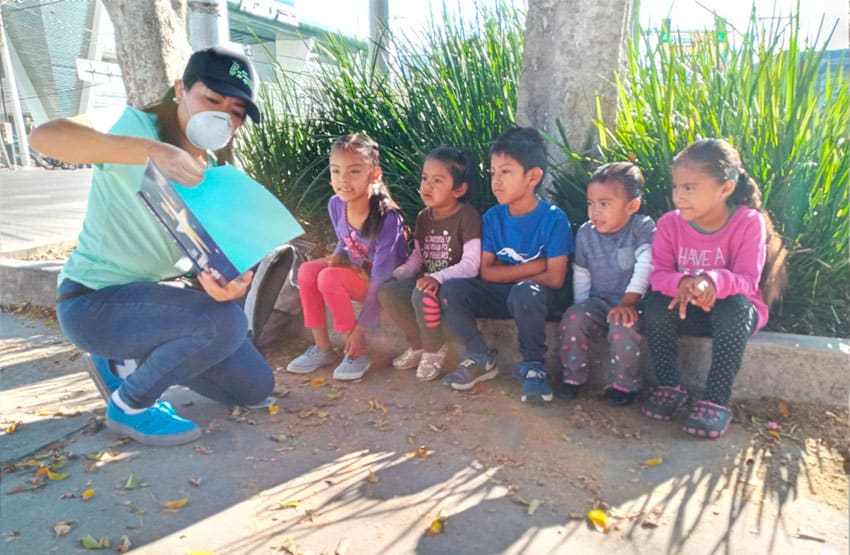
Peláez began to give Dany and other migrant and homeless children classes outside, right on the street corners where they spent their time.
“It made me sad to see the great need that exists in Mexico and the children in poverty. It has become normalized for children to ask for money in the street or sell things at the stoplights. I would go home crying. I covered two stoplights, but there were many more.”
Peláez asked for help on social media and gathered more volunteers. Now, her “stoplight learning” initiative has 23 street-corner classrooms managed by volunteer teachers in her state of Querétaro and 90 teaching places at the national level. Her strategies have been replicated in Jalisco, Mexico City and Veracruz.
Jemima Peláez’s ‘stoplight learning’ program in Querétaro.
As for Dany, who dreams of being a teacher, she can now read and write.

Peláez is also working to set up schools that are easier to enter for vulnerable students, many of whom do not have birth certificates and other paperwork normally required to sign up for school.
Another teacher, Rodrigo Rubio, took a different approach to reach his students, many of whom were not signing in for their online classes. He surveyed students and found that TikTok was their most-used social media network so he set up an account and familiarized himself with the video sharing app. Soon he was dancing, dressing in costumes, even riding a dinosaur in his quest to entertain his students.
Before, he said, he would remind them of class but few would log in. Now, with a constant stream of funny videos keeping them connected to their teacher, “They want more. They are connected!” Rubio said.
Carlos Rodríguez of Monterrey, Nuevo León, had also lamented the loss of connection with his students. Now known on social media by the nickname “The Cool Teacher,” he decorated his classroom in the style of the Mario Bros. videogame.
It’s complicated enough, he said, to hold the attention of 40 children in a classroom but to connect with them through distance learning is more so.
But by being innovative with his presentations online, such as the use of the Mario Bros. theme, Rodríguez has not only connected with this students but attracted new ones that were not in his class.
“It’s gratifying to see now, in spite of not personally knowing them, I have created this link with the students.”
The teacher of 33 years, conscious that his students have only one childhood, says he tries to make it a memorable one and “give it all he’s got.”
Source: Reforma (sp)