After discovering a treasure trove of sacrificial offerings in the heart of Mexico City, archaeologists believe that the uncovering of an Aztec emperor’s tomb could be next.
Archaeologists from the National Institute of Anthropology and History (INAH) have already found the remains of a richly adorned jaguar dressed as a warrior and a young boy dressed to resemble Huitzilopochtli – a deity of war, sun and human sacrifice – near the steps of the Templo Mayor, a temple located behind the Metropolitan Cathedral in the capital’s historic center.
The INAH team has also found a set of flint knives decorated with mother of pearl and precious stones.
The news agency Reuters revealed the details of the offerings in an exclusive report published yesterday.
It said the offerings were deposited by Aztec, or Mexica, priests more than five centuries ago in a circular, ritual platform in front of the Templo Mayor, which Aztecs believed was at the center of the universe.
Tlatoanis, or rulers, of Tenochtitlán – the Aztec capital – are also believed to have been buried there but despite decades of digging, a royal tomb has never been found.
But according to chief archaeologist Leonardo López Lujan, that could soon change.

“We have enormous expectations right now,” he told Reuters. “As we go deeper we think we’ll continue finding very rich objects.”
So far, archaeologists have only excavated about one-tenth of a large rectangular stone box in which the remains of the sacrificed jaguar were found.
In addition to the west-facing jaguar, a spear thrower and a carved wooden disc representative of Huitzilopochtli, which was placed on the feline’s back, have also been discovered along with a large quantity of shells, a bright red starfish, coral and a roseate spoonbill, a pink bird from the flamingo family.
The marine artifacts are believed to have represented the watery underworld that Aztecs believed the sun passed through at night before rising in the east at the start of a new day.
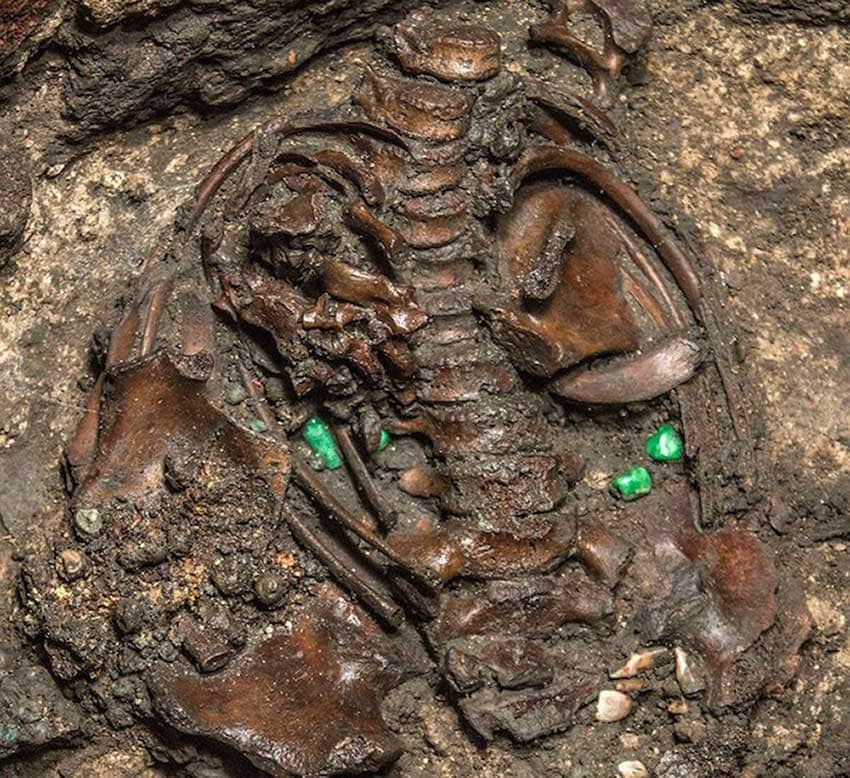
A wooden disc, a necklace made of jade brought from Central America and wings made from hawk bones were found with the approximately nine-year-old sacrificed boy, who likely had his heart ripped out during the death ritual to which he was subjected.
Several decades after the Spanish conquest of Mexico, chroniclers wrote about the burials of three Aztec tlatoanis, the brothers Axayacatl, Tizoc and Ahuitzotl, who ruled consecutively from 1469 to 1502.
The accounts said the rulers’ cremated remains were placed in or near the circular platform of the Templo Mayor with extravagant offerings and the hearts of sacrificed slaves.
Thirteen years ago, a massive monolith of Coatlicue, the Aztec earth goddess, was discovered nearby with an inscription corresponding to 1502, the year Ahuitzotl died and was succeeded by Moctezuma II.
Elizabeth Boone, a pre-Hispanic Mexico specialist at New Orleans’ Tulane University, said the death of Ahuitzotl – considered the Aztec empire’s greatest ruler – would have been marked with lavish offerings and that the jaguar could be representative of his status as a fearless warrior.
“You could have Ahuitzotl in that box,” she said.
However, Miguel Baez, another archaeologist working on the excavation project, explained that “there’s an enormous amount of coral that is blocking what we can see below.”
Archaeologists are expected to continue looking through the newly-discovered offerings and searching for new ones over the coming months but accessing the depths of the deposit boxes in the ritual platform is not the only challenge they face.
The new federal government has cut the project’s budget by 20% this year as part of its austerity plan, several archaeologists told Reuters, and almost all the members of the 25-person INAH team haven’t been paid since December.
Source: Reuters (en)