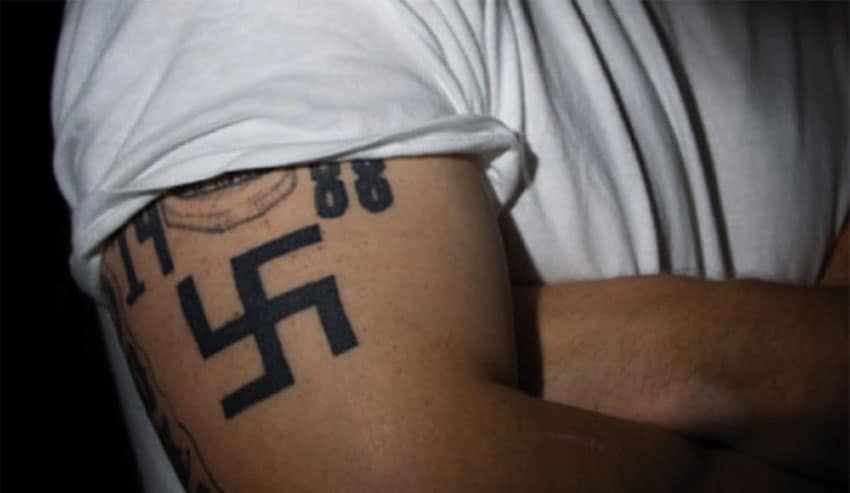
Court rules against dismissed employee over swastika tattoo

The Supreme Court has refused to grant constitutional protection to a man who demanded compensation from a former employer who fired him for displaying a swastika tattoo.

The court voted unanimously on Wednesday to uphold the ruling of presiding judge Norma Piña Hernández, who determined that in today’s cultural environment, the swastika “represents [anti-Semitic] hate speech.”

Court documents state that the man’s coworkers, the majority of them Jewish, “felt offended, attacked or abused” from his first day on the job.

Also Jewish, the man’s boss stated he had “clearly defined convictions on the issue.”

The company had asked the man to cover or remove the tattoo in order to keep his job as invoice manager, but he refused.

“His contract was terminated, with severance, for which the complainant signed the respective resignation and settlement,” court documents indicated.

The man immediately filed a lawsuit against the company for moral damages, with the argument that he had been the victim of discrimination.

He claimed it had affected “legal assets of his personality,” having caused “inconvenience, confusion, annoyance and generally hurt his feelings.”

The company maintained that the Nazi symbol “represented anti-Semitic expression that signified hate and defeat for the Jewish community, and that such an image affected the dignity of the company’s employees and managers who belong to that community.”

Judge Piña ruled in favor of the company, rejecting the discrimination argument, calling the swastika an “apologia of hate.”

“The measures taken by the company in the name of human dignity and the security of its employees and managers were valid, reasonable and proportional,” read her ruling. “As such, they cannot constitute an act of discrimination against the complainant. Therefore, they do not define a legal right to compensation for moral damages.”

Source: Milenio (sp)

Have something to say? Paid Subscribers get all access to make & read comments.
Manzanillo, Colima, México, 13 de marzo de 2026. La doctora Claudia Sheinbaum Pardo, presidenta Constitucional de los Estados Unidos Mexicanos en conferencia de prensa matutina, “Conferencia del Pueblo” desde Colima. La acompañan Indira Vizcaíno Silva, gobernadora Constitucional del Estado de Colima; Omar García Harfuch, secretario de Seguridad y Protección Ciudadana (SSPC); Raymundo Pedro Morales Ángeles, secretario de Marina (Semar); Bulmaro Juárez Pérez, divulgador de lenguas originarias, presentador de la sección “Suave Patria”; Ricardo Trevilla Trejo, secretario de la Defensa Nacional (Sedena); Jesús Antonio Esteva Medina, secretario de Infraestructura, Comunicaciones y Transportes; Bryant Alejandro García Ramírez, fiscal general del Estado de Colima; Fabián Ricardo Gómez Calcáneo; Rocío Bárcena Molina, subsecretaria de Desarrollo Democrático, Participación Social y Asuntos Religiosos de la Secretaría de Gobernación; Efraín Morales López, director general de la Comisión Nacional del Agua (Conagua); Marcela Figueroa Franco, secretaria ejecutiva del Sistema Nacional de Seguridad Pública (SESNSP) y Guillermo Briseño Lobera, comandante de la Guardia Nacional (GN). Foto: Saúl López / Presidencia

Mexico’s week in review: Congress deals Sheinbaum her first legislative defeat

1
The week of March 9 in Mexico was marked by standoffs between allies in Congress and adversaries at the airport. Here's what you missed.
A soldier displays seized handguns

The US and Mexico, growing together and growing apart: A perspective from our CEO

1
From a historic drop in homicides to opposite bets on electric vehicles, Mexico News Daily's CEO breaks down where the U.S. and Mexico are converging — and where they're not.
Veracruz Gov.

Veracruz governor blames private vessel for 200-kilometer Gulf Coast oil spill

1
The spill, which has spread to over 200 kilometers of Mexico's Gulf Coast beaches, has been traced to a private oil tanker off the coast of Tabasco.
BETA Version - Powered by Perplexity