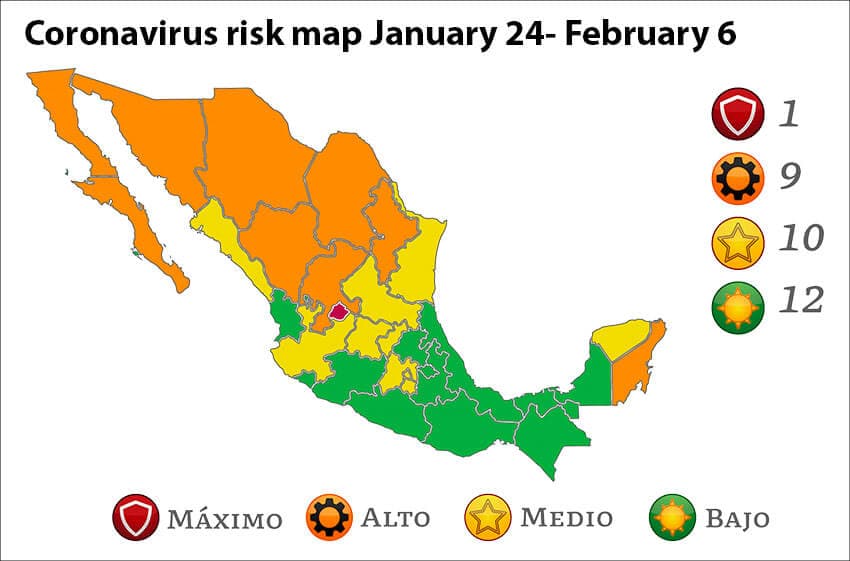
Maximum risk red appears on the federal government’s coronavirus stoplight map for the first time this year as the fourth wave of infections continues to grow.
The small Bajío region state of Aguascalientes is red on the updated map, which takes effect Monday and remains in force through February 6.
Nine states are high risk orange, 10 are medium risk yellow and 12 are low risk green. There were 19 green states on the previous map and just three orange ones, but case numbers have exploded recently as the highly contagious omicron variant spreads rapidly across the country.
Among the 32 states, Aguascalientes – yellow on the previous map – has the highest occupancy rate for hospital beds with ventilators, with 65% currently in use.
Almost three-quarters of general care beds are taken in the state, which has just over 3,000 active cases, or about 200 per 100,000 people, according to the latest Health Ministry data.
Eight of the nine orange states are in Mexico’s north. The northern border states of Baja California, Sonora, Chihuahua, Coahuila and Nuevo León are all high risk as are Baja California Sur, Durango and Zacatecas.
The only orange state not in the north is tourism-oriented Quintana Roo, where Cancún, Playa del Carmen and Tulum are located.

The 10 medium risk states are Mexico City, México state, Guanajuato, Querétaro, Jalisco, Morelos, San Luis Potosí, Sinaloa, Tamaulipas and Yucatán. The 12 green states include Mexico’s five southernmost Pacific coast states and the Gulf coast states of Campeche, Tabasco and Veracruz.
The entry into force of the new map comes after Mexico recorded just under 300,000 confirmed cases over the past seven days.
A new single-day record of 60,552 new cases was set last Wednesday, and over 50,000 were reported on each of Thursday and Friday before the daily count fell to 49,906 on Saturday.
The Health Ministry reported 20,872 additional cases on Sunday, lifting Mexico’s accumulated tally to 4.66 million. There are just over 338,000 estimated active cases.
The daily average of reported case numbers is up 910% in January compared to December, but COVID-19 deaths are down 2% to an average of 163 per day in the first 23 days of the month.
An additional 98 fatalities were reported Sunday, increasing the official death toll to 303,183.
In other COVID-19 news:
• The national occupancy rate for general care beds in COVID wards is 41%, while 25% of beds with ventilators are taken, the Health Ministry reported Sunday.
Durango has the highest rate in the former category with 83% of beds in use. Three-quarters of general care beds are taken in Nuevo León, while the occupancy rate is 73% in each of Aguascalientes and Mexico City.
• Health Ministry data shows that 516 children were hospitalized for COVID-19 between January 9 and 15, the highest number for a single week since the beginning of the pandemic. The previous high was 396 between August 15 and 21 of last year, when Mexico was amid a delta-fueled third wave.
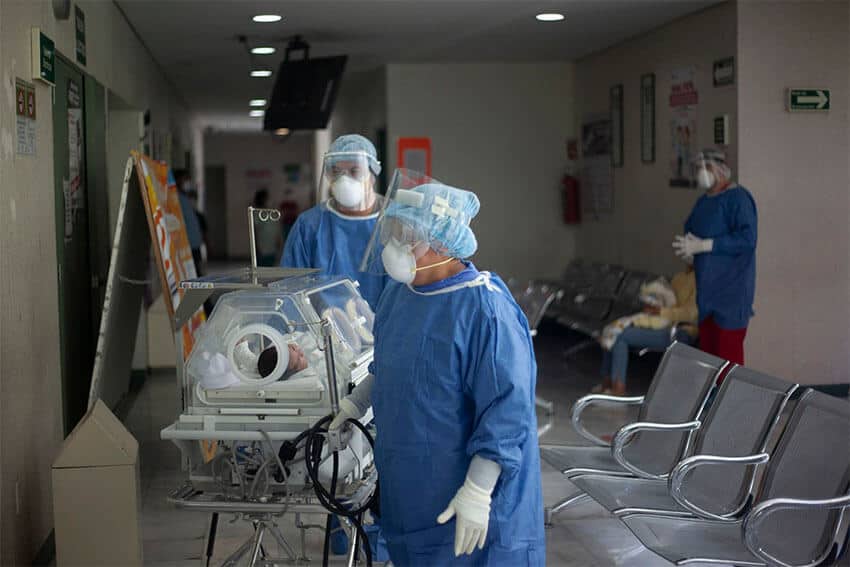
Almost 12,000 children have been hospitalized for COVID since the beginning of the pandemic and just over 1,000 have died. Infants aged two and under account for 37% of hospitalizations among minors.
• Baja California Sur still has the highest number of cases on a per capita basis with over 1,000 per 100,000 people. Mexico City ranks second with more than 800, while each of Tabasco and Colima has over 600.
• More than 83.3 million people have been vaccinated in Mexico, of whom 93% are considered fully vaccinated. The federal government began a booster shot program last month with seniors and teachers given priority.
People aged 40 and over can register their interest in receiving a booster shot on the government’s vaccination website.
• The northern state of Nuevo León will be the first to have all citizens aged five and up vaccinated against COVID, the governor announced after obtaining a donation of 500,000 Pfizer shots from its U.S. neighbor, the state of Texas.
Samuel García said his state will set an example for all of Mexico within three months by vaccinating children aged five to 14, something the federal government — which is vaccinating youths aged 15 and up — has declined to do.
• Despite the increase in case numbers, classes and large events such as concerts won’t be canceled in Mexico City, said Mayor Claudia Sheinbaum.
Although the capital regressed from green to yellow on the stoplight map,“the city’s activities are not changing,” she said Sunday.
“… We’re asking people to take care and the strategy is to vaccinate [residents with a third dose] as soon as possible,” Sheinbaum said, adding that she expected all citizens to have received a booster shot by the end of February.
Mexico City currently has more than 73,000 active cases, meaning that about one in five confirmed cases over the past two weeks were detected in the capital.
The megalopolis leads the country for both total cases and COVID-related deaths with 1.16 million of the former and 53,189 of the latter.
With reports from Reforma, El Universal and Milenio