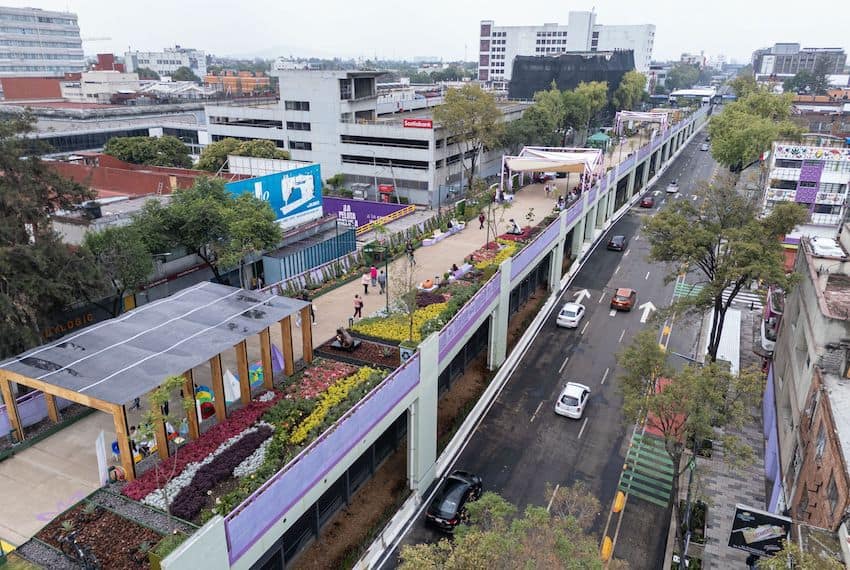
On Sunday, Mexico City Mayor Clara Brugada inaugurated the Tlallipan Floating Garden, a 1.8-kilometer-long verdant pedestrian walkway that, despite the flotante in its Spanish name, is actually propped above the traffic-heavy Calzada de Tlalpan thoroughfare (the tlallipan variation indicating roughly “above the land”).
The 15,400-square-meter walkway, which follows Metro Line 2, connecting the Pino Suárez and Chabacano Metro stations, is expected to help transform one of the city’s busiest roads into a multimodal route for cars, cyclists and pedestrians.
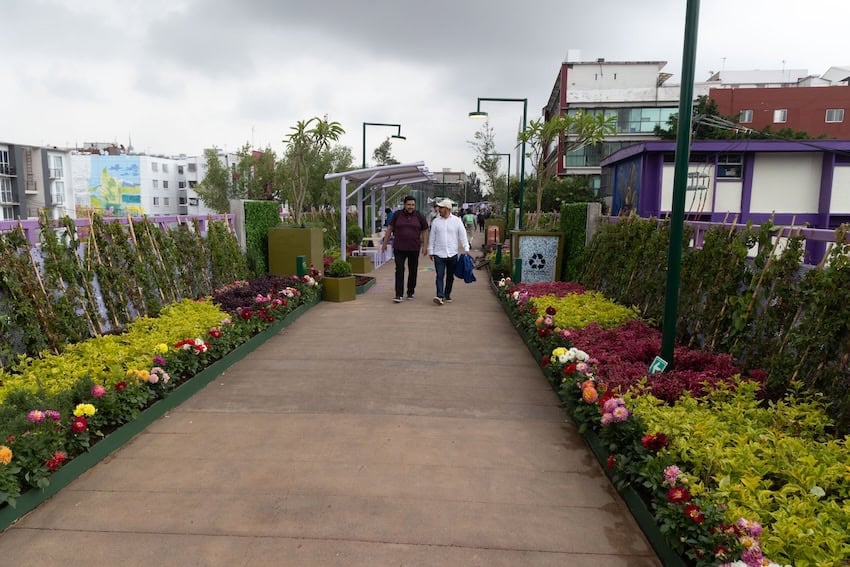
During the opening ceremony, Mayor Brugada emphasized the importance of transforming the car-dominated route into a green oasis for pedestrians, family gatherings and sustainable mobility.
“On its first day, the Tlallipan Floating Garden welcomed thousands of visitors who enjoyed a new and beautiful public space for gathering, culture and community,” Brugada wrote on X on Sunday.
Tlallipan was designed with 6,200 square meters of green space, including 176 trees, 2,000 shrubs, and over 8,000 plants. Project developers prioritized endemic species and pollinating plants such as the Mexican cord tree, tlacote, flame tree and peninsular myrtle.
As part of the “From the Countryside to the City” program, farmers from chinampa and rural areas of Mexico City will be permitted to sell local products along the walkway.
The corridor is divided into seven sections, with each named after a species endemic to the Valley of Mexico — the axolotl, the xoloitzcuintle (Mexican hairless dog), the hummingbird, the volcano rabbit, the ring-tailed cat, the blackbird and the Tláloc frog.

Tlallipan connects other pedestrian walkways, public transportation stations, the Gran Tenochtitlán bike path and the Camina Libre, Camina Segura (Walk Freely, Walk Safely) trail, which extends 34 kilometers from the Historic Center to the Periférico ring road in the south. The project is part of the city’s Safe and Free Women’s Paths model, which includes 900 lights and emergency alarm buttons.
There are seven pergolas and eight shade structures for recreational activities, 64 rest areas, 18 sculptures, nine fountains with illuminated water jets and a giant screen for film screenings along the walkway. Digital totems with interactive screens allow users to access information about Mexico City.
The project also incorporates several community facilities, such as health clinics, community kitchens, free laundromats and animal welfare services.
The walkway is free and can be accessed via two staircases, located at either end of the corridor, open daily during the Metro’s opening hours, from 5 a.m. to midnight.