This week’s powerful earthquake in Colombia has revived fear in Mexico: Is the Pacific Ring of Fire about to send another major tremor north?
The answer is no. Although Mexico faces real seismic risk, Monday’s 7.4-magnitude quake in western Colombia is not a scientific warning that Mexico is next.
Colombia’s Geological Service said the quake was the country’s strongest of the 21st century. The death toll had risen above 200 by Tuesday as rescue operations continued, Reuters reported.
Mexican President Claudia Sheinbaum has pledged “all the support” Colombia needs, depending on a formal request from Colombian authorities.
The Venezuelan state news outlet Telesur reported Tuesday that Mexico is prepared to deploy a 255-member military search-and-rescue team, along with satellite phones, radios, electric generators, tents, four tons of medicines, 8.4 tons of tools and rescue equipment, 8,798 food packages and 13,890 food baskets.
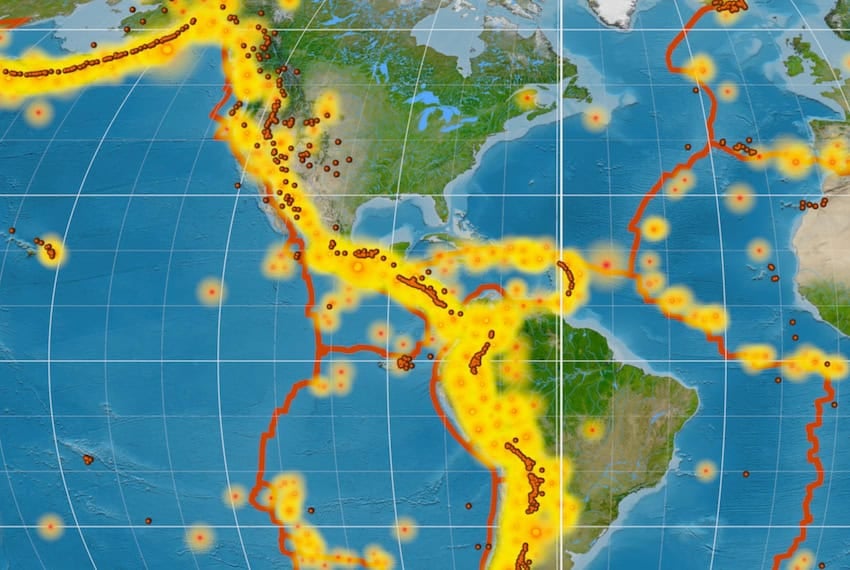
Mexico and Colombia sit on the vast belt of faults, volcanoes and subduction zones that partly encircles the Pacific Ocean. The Cinturón de Fuego del Pacífic, or Pacific Ring of Fire, stretches about 40,000 kilometers from New Zealand through Indonesia, the Philippines and Japan; across the Aleutian Islands; and down the Pacific coasts of the Americas to Chile.

It is associated with roughly 90% of the world’s earthquakes and three-quarters of its active volcanoes.
But a shared belt does not make the two countries part of one seismic domino line.
In Colombia, seismic and volcanic activity reflects the interaction of the Nazca, South American and Caribbean plates.
Monday’s quake was linked principally to the Nazca-South American plate system.
Mexico’s principal Pacific-coast hazard comes from the Cocos Plate pushing beneath the North American Plate; the Rivera Plate is also a factor in the west. That configuration drives Mexico’s seismicity and volcanic systems.
Scientists know that seismic waves from a major earthquake can sometimes disturb faults far from the epicenter, a phenomenon known as dynamic triggering. But that possibility does not allow them to forecast a destructive earthquake in Mexico.
Likewise, a series of earthquakes across Latin America does not mean the Pacific Ring of Fire has been “activated.” Plates are always moving, accumulating and releasing stress along separate faults at different depths.
With reports from El Financiero, Infobae, WRadio and La Razón de México