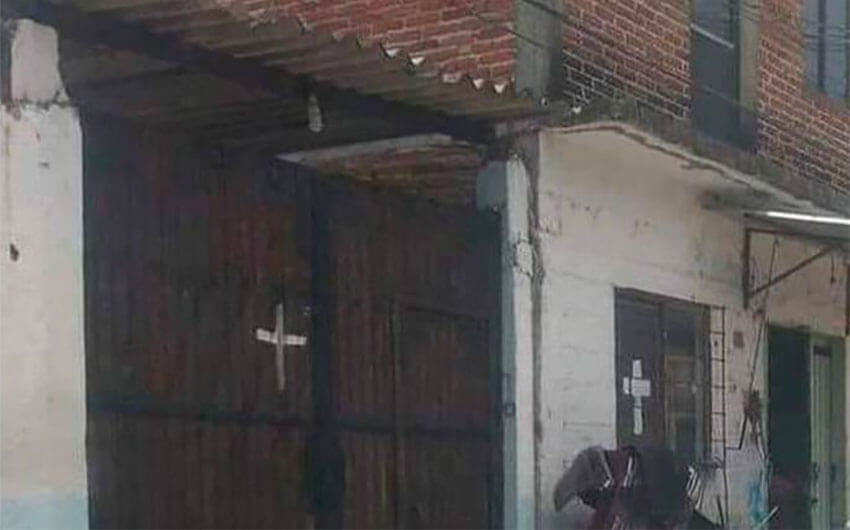
The belief that a supernatural being is lurking nearby has led some residents of a Morelos town to paint white crosses on their homes for protection.
Some Cocoyoc residents say they began hearing strange noises in the early hours of the morning two weeks ago. As they couldn’t attribute the noises to an animal or any other source, they concluded they were made by a nagual (or nahual), which in Mesoamerican folk religion is a human being who has the power to transform, or shape-shift, into an animal.
“First it was a few residents who started … [talking about the noises] and then, as days passed, more people asserted they had heard the same thing,” Luis Salgado, a Cocoyoc local, told the newspaper El Sol de Cuautla.
At some point, one person suggested that the noises were made by a nagual and other residents agreed. They concluded that they needed to do something to ward off the supernatural being so they decided to paint white crosses on their homes.
The crosses mainly appeared on homes on Buenos Aires Street, where Salgado says violent incidents have occurred. However, in recent days, fear of the nagual has extended to other parts of Cocoyoc, a town about 30 kilometers east of Cuernavaca in the municipality of Yautepec. Residents are so afraid that they are staying inside after 10 p.m., El Sol said.
News of the Cocoyoc resident’s belief and photographs of the white crosses on people’s doors and windows went viral on social media, triggering a range of responses, including mockery, and even leading to the creation of nagual memes. Salgado spoke out in defense of the belief, noting that the town – part of a region of Morelos where indigenous Nahua people live – is governed by the indigenous governing code known as usos y costumbres.
Gustavo Garibay, a historian, also observed that traditional beliefs remain strong in Cocoyoc.

“Sometimes we forget that … Cocoyoc is a town with a Nahua tradition. This cultural influence prevails in ideas and healing ritual beliefs. Let’s not forget that Cocoyoc is a cultural stronghold where until relatively recently there were still practices of magic and [traditional] healers,” he said.
Another town where fear of the nagual overtook residents is Soledad del Doblado, Veracruz, where men, women and children armed with rocks, shovels and guns ventured out of their homes in August 2020 to attempt to kill or drive away the mythical creature.
A nahual, whose name comes from a Náhuatl word used to describe the purported ability of individuals to transform into animals or natural phenomena, is believed to use its power for either good or evil depending on its personality.
“Whether they use their powers for the benefit or detriment of others wholly depends on whether the individual’s personality … is benevolent or malevolent,” according to an article by Mexican digital publisher Cultura Colectiva.
With reports from El Sol de Cuautla and Plumas Atómicas