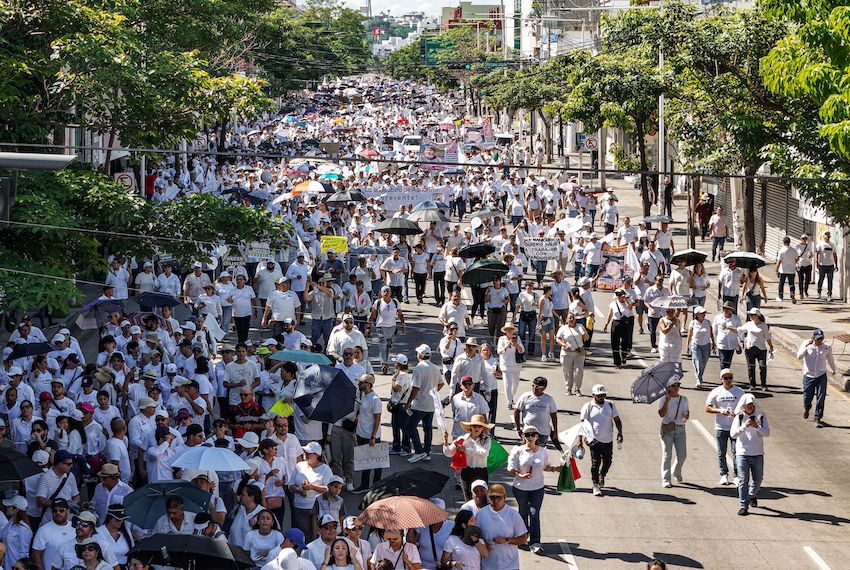
Tens of thousands of people took to the streets of Culiacán, Sinaloa, on Sunday to call for peace in the city and northern state amid an unrelenting wave of cartel violence.
The march for peace in the Sinaloa state capital took place almost a year after the escalation of a long-running dispute between rival factions of the Sinaloa Cartel, namely Los Chapitos and Los Mayos.
More than 1,800 people have been killed in Sinaloa in the past year amid the cartel infighting — in effect, a war that was ignited by the arrest in the United States last year of Ismael “El Mayo” Zambada, who claims he was kidnapped by one of the sons of Joaquín “El Chapo” Guzmán and forced onto a U.S.-bound plane. Some 2,800 people have disappeared in the same period, according to activists.
The cartel battle has generated immense fear among residents of Culiacán and other parts of Sinaloa, leaving many afraid to leave their homes. The bloody conflict has had a devastating impact on many businesses, causing extensive economic and job losses.
On Sunday, tens of thousands of those people marched along Álvaro Obregón Avenue in Culiacán to demand greater action from authorities to quell the violence. According to some media reports, more than 50,000 people participated in the protest. The organizers cited a more modest, but still large, figure of 20,000.
‘Enough! We want peace’
The march for peace was organized by some three dozen civil society organizations, including the Culiacán branch of the Mexican Employers Federation (Coparmex) and a group called Ciudadanos Unidos (Citizens United).
“Enough! We want peace,” said a flyer that circulated on social media to promote the march. The same message appeared on huge banners carried by protesters, who marched from a Catholic church known as La Lomita to the Culiacán Cathedral.

Mostly dressed in white, the marchers included business owners, lawyers, politicians, doctors, nurses, children and madres buscadoras (searching mothers), women whose lives were turned upside down by the disappearance of their children.
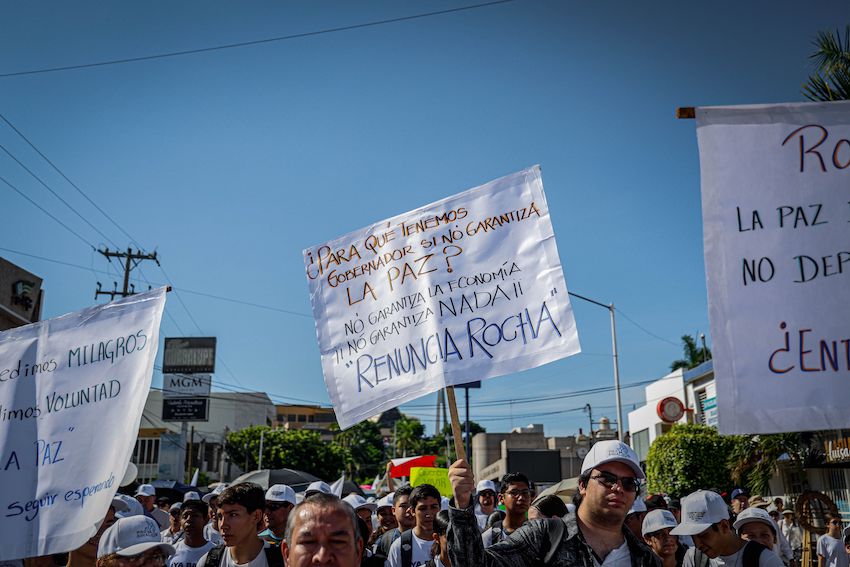
Among the messages they sent to authorities — and cartel members — were: “The narco does not rule, Sinaloa is ours”; “Enough, we demand peace”; “Culiacán is rising up, violence won’t defeat us”; and “There are more of us good guys.”
A boy walking under the hot Culiacán sun declared that “children deserve to live without violence,” according to a report by the newspaper Reforma.
“My voice is small, but my right to peace is big,” read a placard carried by one child, the newspaper Milenio reported.
“We want to be able to go outside to play without fear,” declared a 10-year-old boy, according to the news magazine Proceso.
In addition to calling for peace and greater action from authorities, marchers demanded the resignation of Sinaloa Governor Rubén Rocha Moya, a representative of the ruling Morena party.
“¡Fuera Rocha!” (Rocha out!) was another of the chants heard during Sunday’s march.
“We demand greater intervention from the government of Mexico in light of the absence of action from Governor Rocha Moya to achieve peace and guarantee security in the state,” said Coparmex Culiacán president Martha Reyes Zazueta.
Protesters also criticized the efforts of Culiacán Mayor Juan de Dios Gámez Mendívil to combat violence in the state capital.
Although more than 10,000 members of federal security forces, including the National Guard and the army, have been deployed to Sinaloa, many residents believe that the Mexican government needs to take stronger action to combat the relentless violence. In the 12 months to August, homicides increased 265% in Sinaloa compared to the previous year, and the incidence of various other crimes also went up.
“We cannot get used to living among bullets,” said Víctor Manuel Aispuro, principal of a Culiacán primary school attended by two children who were shot and killed along with their father in January.
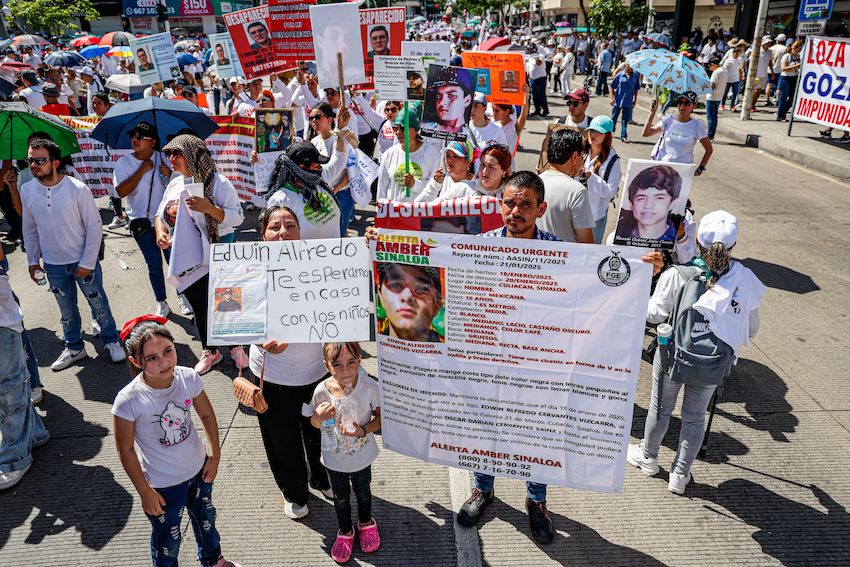
Around 40 children have been murdered in Sinaloa over the past year, including at least 15 who were collateral damage, Milenio reported.
‘Each step is a plea for peace’
Before the march began, Culiacán Bishop Jesús José Herrera Quiñonez addressed the people gathered at La Lomita, officially called the Parish Church of Our Lady of Guadalupe.
“We have gathered because for a year we have been experiencing these events that fill us with pain and uncertainty in our city of Culiacán,” he said.
“Evil does not have the last word, because the love of God is stronger than violence, and that is something we have to understand,” Herrera said.
“Our march today is prayer in motion, each step is a plea for peace, each of our cries is a cry of hope, each person’s presence is testimony that we do not resign ourselves to living under the shadow of fear. We walk together because we know that peace is not a distant dream, but an urgent task that God places in our hands,” he said.
An economic crisis
According to Óscar Sánchez, leader of a Culiacán business association, some 2,000 businesses have shut due to reasons related to violence and insecurity. He said that 40,000 jobs have been lost, while the economic losses of affected businesses are as high as 20 billion pesos (almost US $1.1 billion).
Protesters on Sunday called on the federal government to take steps to ease the economic crisis in Culiacán and other parts of Sinaloa. Among the measures they asked for were tax relief, a suspension of electricity bills and the provision of loans to help businesses get back on their feet and thus reactivate the Sinaloa economy.
With reports from Reforma, Debate, Milenio, La Jornada, Infobae and Proceso