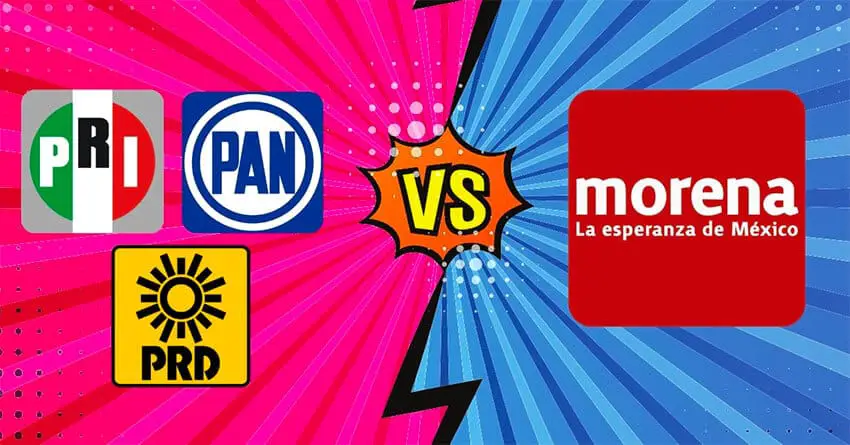
Mexico’s opposition is on track to lose four state governorships to the ruling party after elections on Sunday, slowing its recent momentum against the country’s populist president and complicating its path to victory in major elections in 2024.
After defeating Morena’s radical energy reform in the lower house earlier this year, some political analysts believed the unified opposition could continue to gather momentum. But Sunday’s preliminary results serve as a bellwether of public opinion and show the group of formerly rival parties is struggling to convert congressional gains into electoral results.
“This strengthens Morena’s narrative . . . that they are powerful,” said Francisco Abundis of polling group Parametria, who noted that quick counts showed Morena likely won by more than 30 percentage points in two states. “[The opposition] should be worried, not just because they lost the governorships as expected but because of the margins.”
The ballots are the last broad electoral test before 2024, when the country will hold elections at all levels of government, including the presidency. The president is limited to one term but Morena’s dominance at the state level will give it advantages in terms of resources and visibility to help López Obrador’s chosen successor win.
Morena’s enduring electoral strength despite weak economic growth is partly down to voter identification with the president, who has approval ratings of almost 60%. His idiosyncratic agenda has married extreme fiscal austerity with combative anti-business rhetoric and regulatory decisions that benefit state companies.
Supporters laud his personal displays of austerity and believe he is standing up for the country’s poorest, while his critics say he has attacked fragile institutions and poses a risk to Mexico’s relatively young democracy.
The shift in power highlighted by Morena’s election victory in 2018 has transformed Mexican politics and significantly weakened the Institutional Revolutionary party (PRI), which had ruled uninterrupted for 70 years until 2000. Hidalgo state, which Morena also won on Sunday, was governed by the PRI and its predecessors since the party’s founding in 1929.

It now holds just a handful of the 32 governorships, two of which are due for elections next year.
Morena has managed to recreate some of the PRI’s dominance but with the key difference that the current elections are democratic, said Arturo Sánchez Gutiérrez, a politics professor at Tec de Monterrey university and former board member of the electoral authority.
“We have a map that looks much like the political system Mexico had before its transition to democracy,” he said, highlighting Morena’s strong majority. “That’s the democratic challenge the country has.”
Both the ruling and opposition coalitions will need to maintain unity in their campaigns to win in two years’ time, analysts said. Foreign minister Marcelo Ebrard and Mexico City Mayor Claudia Sheinbaum, Morena’s leading candidates, are already touring the country seeking votes. Senate leader and fellow Morena hopeful Ricardo Monreal has warned that the process for choosing the next candidate must be transparent.
Among the three-party opposition, a clear leader or potential candidate has not yet emerged. In another blow, the center-left Citizens Movement said on Sunday it would not join the alliance for state governorship votes in 2023.
“The opposition hasn’t managed to build an alternative narrative, much less position its candidates,” Sánchez said. “That’s maybe the biggest challenge they will have in the next two years.”
© 2022 The Financial Times Ltd. All rights reserved. Please do not copy and paste FT articles and redistribute by email or post to the web.