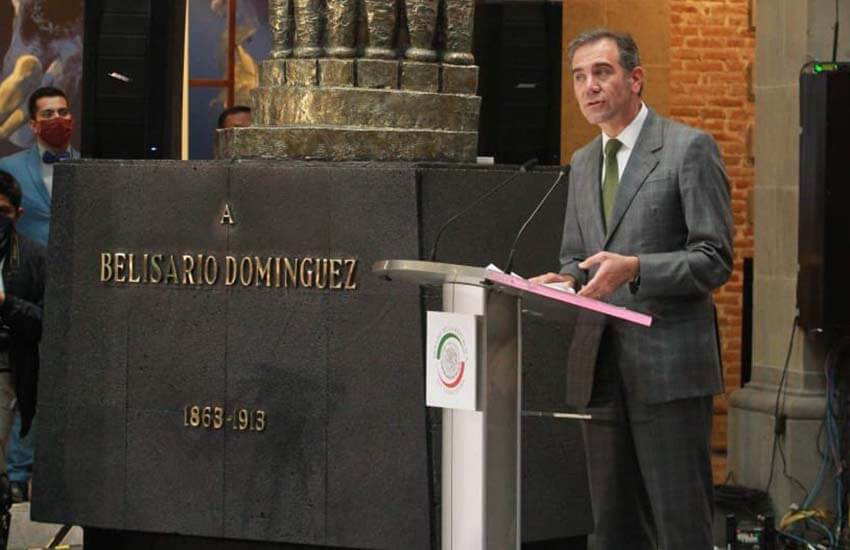
President López Obrador’s proposed electoral reform would sabotage democracy in Mexico, the head of the National Electoral Institute (INE) said Friday.
Sent to the lower house of Congress last Thursday, López Obrador’s constitutional reform bill would dissolve the INE and replace it with a less-well-funded, directly elected body.
It would also cut public funding to political parties, loosen electoral campaigning rules, reduce the number of federal and state lawmakers and introduce electronic voting.
As it seeks to change the constitution, the reform — which López Obrador says would generate huge savings — requires support from two-thirds of lawmakers to pass Congress. The ruling Morena party and its allies have a majority in both houses but don’t command a supermajority in either, meaning the bill is unlikely to be approved in its current form.
Speaking to reporters at an event in Mexico City last Friday, INE president Lorenzo Córdova described the proposed reform as a threat to democracy because it entails a “democratic regression.”
He acknowledged that the rules governing elections in Mexico could be improved but asserted that the current system is an international example of how to guarantee democratic certainty.
Lawmakers who support the bill without seeking to change even a comma would be sabotaging the country’s transition to democracy, Córdova said.

That transition, many scholars argue, was completed in 2000 when the National Action Party won control of the federal government after over more than 70 uninterrupted years of Institutional Revolutionary Party rule.
Córdova said that electoral changes over the past 30 years were made in response to shared needs and problems. There was a consensus about how to respond to those needs and confront those problems, he said, before implying that there is now no such agreement between the country’s political parties.
López Obrador, an outspoken critic of the INE who has clashed with its chief on several occasions, said Thursday that “there is no intention to impose a single party” with the proposed reform and “what we want is for there to be an authentic, true democracy in the country and to end electoral fraud.”
But Córdova questioned the need to overhaul the electoral system given that the INE – one of the country’s most trusted institutions – has organized over 300 elections that guaranteed citizens’ right to freely choose their political representatives.
With reports from Infobae