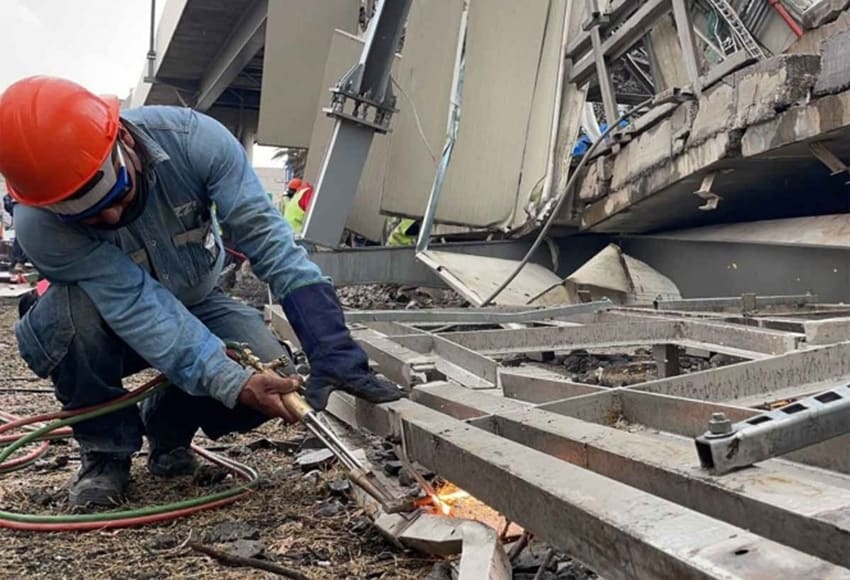
Engineers say 68% of Metro’s elevated section requires attention

Almost one-third of the elevated section of the Mexico City Metro’s Line 12, where an accident last month killed 26 people, shows signs of damage, the Mexican College of Civil Engineers said Thursday.

Bernardo Gómez Gonzáles, head of the college’s structural safety technical committee, told a press conference that 101 experts inspected most of the elevated section of the subway line, which runs between Atlalilco and Tláhuac stations, both in the Iztapalapa borough.

The only part they didn’t inspect was the section where the May 3 tragedy occurred. The collapse of that section was caused by a series of faults during construction, according to the preliminary results of an independent inquiry.

Gómez said the inspection determined that 32% of the elevated section of Line 12, the Metro system’s newest, has “grade B” damage that requires repair.

Among the problems engineers detected were cracks in concrete support columns, insufficient separation between steel beams and concrete slabs on the overpass and welding deficiencies.

The sections on the line where damage was found are not necessarily “high-risk” but “must be analyzed with greater detail,” Gómez said, adding that 68% of the elevated section has “grade C” damage, or common wear and tear, that requires routine maintenance.

The committee Gómez heads advised against resuming services on any section of the line until further inspections and the required repair work are carried out.

It offered that advice even though inspections haven’t identified any structural problems with the underground section of the line, which continued to operate in 2014 while the elevated section was closed for repairs.

“The tunnel section of Line 12 of the Metro doesn’t have structural damage nor deformations that place its stability at risk,” said Francisco Suárez Fino, president of the Mexican College of Civil Engineers’ tunnels and underground projects association.

“The main problems it has are due to [water] leaks … that, with adequate maintenance and an efficient water capture and management system, can be resolved,” he said.


With reports from Milenio  and Televisa 

Have something to say? Paid Subscribers get all access to make & read comments.
Manzanillo, Colima, México, 13 de marzo de 2026. La doctora Claudia Sheinbaum Pardo, presidenta Constitucional de los Estados Unidos Mexicanos en conferencia de prensa matutina, “Conferencia del Pueblo” desde Colima. La acompañan Indira Vizcaíno Silva, gobernadora Constitucional del Estado de Colima; Omar García Harfuch, secretario de Seguridad y Protección Ciudadana (SSPC); Raymundo Pedro Morales Ángeles, secretario de Marina (Semar); Bulmaro Juárez Pérez, divulgador de lenguas originarias, presentador de la sección “Suave Patria”; Ricardo Trevilla Trejo, secretario de la Defensa Nacional (Sedena); Jesús Antonio Esteva Medina, secretario de Infraestructura, Comunicaciones y Transportes; Bryant Alejandro García Ramírez, fiscal general del Estado de Colima; Fabián Ricardo Gómez Calcáneo; Rocío Bárcena Molina, subsecretaria de Desarrollo Democrático, Participación Social y Asuntos Religiosos de la Secretaría de Gobernación; Efraín Morales López, director general de la Comisión Nacional del Agua (Conagua); Marcela Figueroa Franco, secretaria ejecutiva del Sistema Nacional de Seguridad Pública (SESNSP) y Guillermo Briseño Lobera, comandante de la Guardia Nacional (GN). Foto: Saúl López / Presidencia

Mexico’s week in review: Congress deals Sheinbaum her first legislative defeat

0
The week of March 9 in Mexico was marked by standoffs between allies in Congress and adversaries at the airport. Here's what you missed.
A soldier displays seized handguns

The US and Mexico, growing together and growing apart: A perspective from our CEO

1
From a historic drop in homicides to opposite bets on electric vehicles, Mexico News Daily's CEO breaks down where the U.S. and Mexico are converging — and where they're not.
Veracruz Gov.

Veracruz governor blames private vessel for 200-kilometer Gulf Coast oil spill

1
The spill, which has spread to over 200 kilometers of Mexico's Gulf Coast beaches, has been traced to a private oil tanker off the coast of Tabasco.
BETA Version - Powered by Perplexity