Environment secretary bullish on lithium, calls it Mexico’s ‘new oil’

Lithium will be Mexico’s “new oil,” Environment Secretary Víctor Manuel Toledo said on Thursday, highlighting the country’s large deposits of the metal used in the manufacture of batteries, among other products.

In fact, the biggest lithium project in the world is in Sonora, according to the company Mining Technology.

It said in August that the mine being developed by Canada’s Bacanora Minerals and China’s Ganfeng Lithium in the municipality of Bacadéhuachi is estimated to hold proven and probable reserves of 243.8 million tonnes, containing 4.5 million tonnes of lithium-carbonate equivalent.

Bacanora has been operating a pilot plant in Hermosillo for the past four years, producing what it says is high-quality, battery-grade lithium carbonate samples for potential customers.

Construction of the mine was first announced by Sonora Governor Claudia Pavlovich in May 2018 and is expected to be completed in the first quarter of 2020. Production capacity in its first stage of operations is expected to be 15,500 tonnes per year of lithium carbonate, Mining Technology said, while capacity will double to 35,000 tonnes per year in a second stage.

That prospect led Toledo to declare that lithium will be Mexico’s “new oil.”
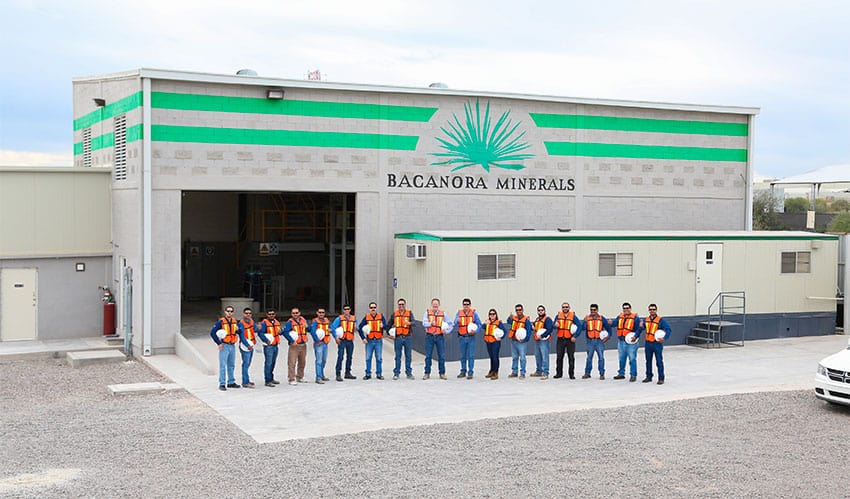
Bacanora's pilot project in Hermosillo, Sonora.
Bacanora’s pilot project in Hermosillo, Sonora.

Potential lithium reserves have also been identified in Baja California, San Luis Potosí and Zacatecas.

The metal, Toledo reporters at the presidential press conference, is “the base not just of computers but also storage batteries” for cell phones and electric cars, among other products.

Therefore, “Mexico should be capable of making electric cars in public factories,” he said, adding that the secretariats of the Environment and Energy are currently analyzing that possibility with Mexico’s “best experts” in the field.

“We’re also one of the richest counties in solar radiation and we’re going to be a country that exports energy to the United States and Latin America,” Toledo added.

“The two most important areas in Latin America for solar radiation are the northeast of Mexico, the deserts, and the border between Chile and Bolivia . . . We’re going to be a solar energy power.”

Source: El Financiero (sp), El Imparcial (sp), Publimetro (sp)  

Have something to say? Paid Subscribers get all access to make & read comments.
Manzanillo, Colima, México, 13 de marzo de 2026. La doctora Claudia Sheinbaum Pardo, presidenta Constitucional de los Estados Unidos Mexicanos en conferencia de prensa matutina, “Conferencia del Pueblo” desde Colima. La acompañan Indira Vizcaíno Silva, gobernadora Constitucional del Estado de Colima; Omar García Harfuch, secretario de Seguridad y Protección Ciudadana (SSPC); Raymundo Pedro Morales Ángeles, secretario de Marina (Semar); Bulmaro Juárez Pérez, divulgador de lenguas originarias, presentador de la sección “Suave Patria”; Ricardo Trevilla Trejo, secretario de la Defensa Nacional (Sedena); Jesús Antonio Esteva Medina, secretario de Infraestructura, Comunicaciones y Transportes; Bryant Alejandro García Ramírez, fiscal general del Estado de Colima; Fabián Ricardo Gómez Calcáneo; Rocío Bárcena Molina, subsecretaria de Desarrollo Democrático, Participación Social y Asuntos Religiosos de la Secretaría de Gobernación; Efraín Morales López, director general de la Comisión Nacional del Agua (Conagua); Marcela Figueroa Franco, secretaria ejecutiva del Sistema Nacional de Seguridad Pública (SESNSP) y Guillermo Briseño Lobera, comandante de la Guardia Nacional (GN). Foto: Saúl López / Presidencia

Mexico’s week in review: Congress deals Sheinbaum her first legislative defeat

1
The week of March 9 in Mexico was marked by standoffs between allies in Congress and adversaries at the airport. Here's what you missed.
A soldier displays seized handguns

The US and Mexico, growing together and growing apart: A perspective from our CEO

1
From a historic drop in homicides to opposite bets on electric vehicles, Mexico News Daily's CEO breaks down where the U.S. and Mexico are converging — and where they're not.
Veracruz Gov.

Veracruz governor blames private vessel for 200-kilometer Gulf Coast oil spill

1
The spill, which has spread to over 200 kilometers of Mexico's Gulf Coast beaches, has been traced to a private oil tanker off the coast of Tabasco.
BETA Version - Powered by Perplexity