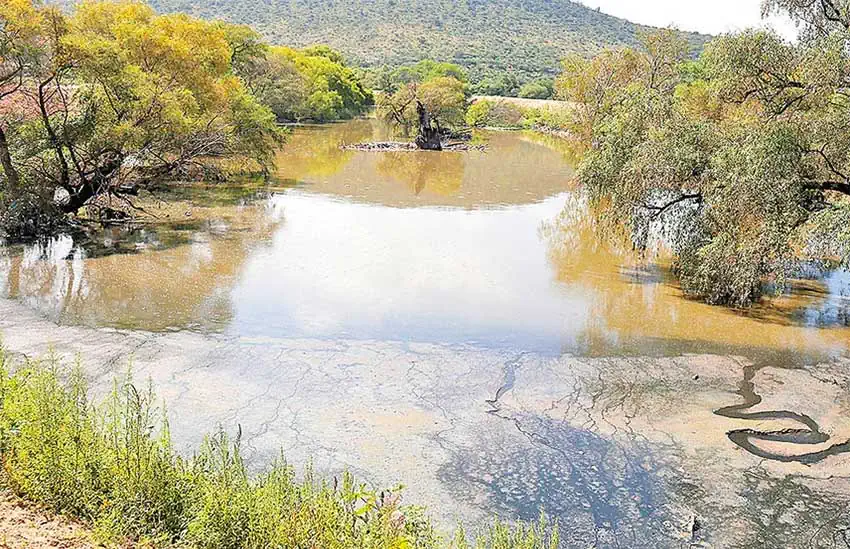
For more than 50 years the Tula river has received wastewater from the Valley of México, but some residents say they have had enough and are demanding that President López Obrador do something about the problem.
René Romero, president of an environmental group, told reporters that residents “. . . demand that the new government deliver justice to the people of Tula for the pollution it has suffered for decades, that it respect environmental regulations, international agreements, the right to health and the right to a healthy environment.
“We believe that the river can be cleaned and restored. If the river’s ecosystem is destroyed, the possibility of restoring the river is also destroyed, and we will be forever condemned to simply maintaining a channel of wastewater.”
But residents probably face a tough battle.
The 62-kilometer Eastern Emission Tunnel, begun by ex-president Felipe Calderón and now six years behind schedule, will dump 150,000 liters of wastewater per second into the Tula river once complete.
There are other environmental concerns as well. Between August and November of 2017, the National Water Commission (Conagua) began lining the river with concrete, which required the removal of 1,500 trees.
“The aim of the project is to widen the river along 19.5 kilometers. This was only the first phase of the project, but the National Water Commission cut down thousands of trees, many of them centenarians,” Romero said.

“Local governments in México state and Mexico City must assume responsibility; they have a historic debt to the people of this region,” Romero said.
Wastewater is transported through underground pipes to the Tula river, where it is then carried through open air to the Endhó dam. The water is used without being treated to irrigate more than 80,000 hectares of agricultural land.
According to the Pan American Health Organization, incidents of gastroenteritis, influenza and amoebic dysentery are much higher in the region than the national average, as are incidents of birth defects and cancer.
“There is a lot of illness, and we know that cancer has a high incidence in this region. The smell is unbearable, but for many years we have had to bear it. Depending on the pollutants contained in the wastewater at any given moment, we are susceptible to respiratory, intestinal and even kidney diseases,” said Saúl Basurto Guerrero, also a member of Romero’s organization.
Carlos Gómez Alfaro, director of another Hidalgo environmental organization, told reporters that both groups have proposed sending the wastewater through the Requena canal for treatment, which was also proposed by López Obrador’s team during the federal transition process.
“We are tired of receiving Mexico City’s wastewater. We want to clean the Tula river,” he insisted.
Source: Milenio (sp)