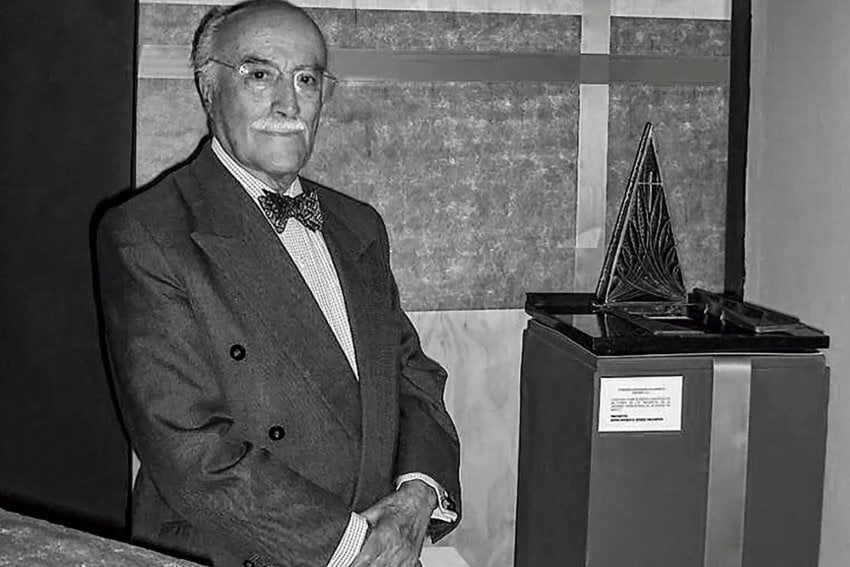
Though you might not know it now, there was a time — particularly during the first half of the 20th century — when architects also engaged in furniture design. Numerous notable examples exist worldwide, including the French architect Le Corbusier, who designed the iconic LC2 and LC4 chairs; the German architect Ludwig Mies van der Rohe, known for the legendary Barcelona chair; and the Finnish-American architect Eero Saarinen, renowned for the Tulip table. Mexico also contributed to this creative wave.
During this period, prominent Mexican architects like Ernesto Gómez Gallardo Argüelles and Pedro Ramírez Vázquez — who created the National Museum of Anthropology and History — and the Mexican-Cuban architect Clara Porset, who designed iconic furniture for figures such as Luis Barragán and Mario Pani, crafted remarkable pieces that significantly impacted the history of design in Mexico. Ernesto Gómez Gallardo Argüelles, in particular, stands out.
Furthermore, in Mexico during the 1970s, there was a convergence of design, industry and government, facilitating the integrated proposal and implementation of various projects. During this time, Ernesto Gómez Gallardo Argüelles emerged as a key figure and was part of the original team of architects who designed and built the National Autonomous of Mexico’s University City, now designated as a UNESCO World Heritage Site.
Ernesto Gómez Gallardo Argüelles and his iconic mobiliary
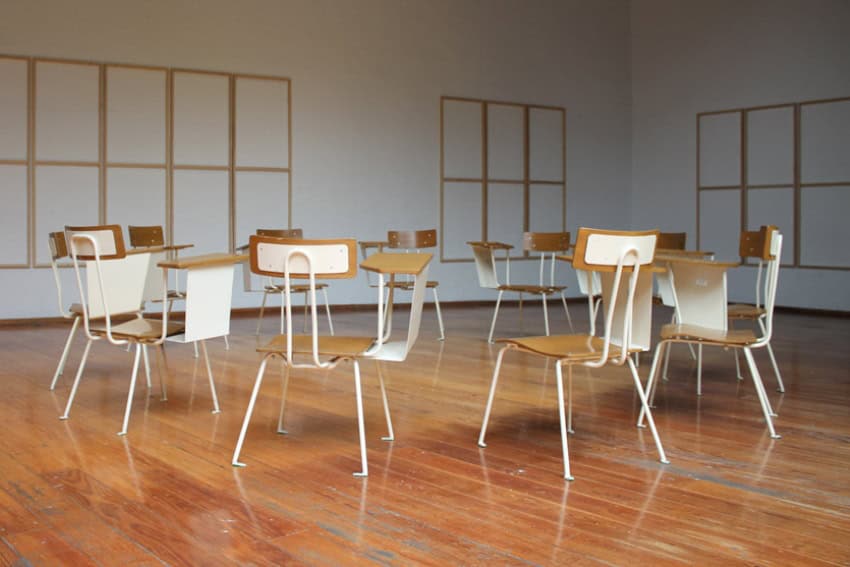
In the late 1950s, the Mexican government sought proposals for the Federal School Construction Program Management Committee, specifically targeting rural schools and appointing Gallardo as the lead. The project aimed to combine industrialized architecture with self-construction, resulting in a prefabricated school model for rural areas. This initiative was part of an 11-year campaign by the Ministry of Public Education to expand educational coverage in regions lacking suitable facilities for children. Gómez’s goal was to design desks entirely of wood, allowing for easy repairs by both teachers and students. Remarkably, his furniture for rural schools is still in use today.
One of his most notable achievements in furniture design is the paleta chair for UNAM. This chair was used in classrooms across the newly constructed university and earned him the Silver Medal at the Milan Design Triennial in 1960. It remained in use at the institution for decades.
Later, in the 1980s, he explored the use of wrought iron in designing street furniture for parks and plazas, creating structures with bent slats that formed seating. Due to its durability, ease of maintenance and ease of production, this type of furniture became integral to the city’s public spaces.
Other highlights of his career
In addition to being one of the architects behind some of UNAM’s most significant buildings, Gallardo designed the high altar of the Metropolitan Cathedral in Mexico City, as well as airports in Zacatecas, Palenque and Tuxtla Gutiérrez in Chiapas.

In terms of architecture, one of his most remarkable works is his own Casa Möbius, characterized by its unique triangular concrete roof, which reflects the architect’s fascination with mathematics. The roof serves as a simplified representation of the Möbius strip, a geometric shape discovered by the German mathematician August Ferdinand Möbius in 1858, resembling an infinite loop.

Furthermore, in academia, Gómez Gallardo served as the Dean of the School of Architecture at the Monterrey Institute of Technology and Higher Education. Like many of his generation, he experimented with creations across various disciplines before hyperspecialization began to impose limitations and opportunities on both the sciences and the arts.
Ana Paula de la Torre is a Mexican journalist and collaborator for various outlets, including Milenio, Animal Político, Vice, Newsweek en Español, Televisa and Mexico News Daily.