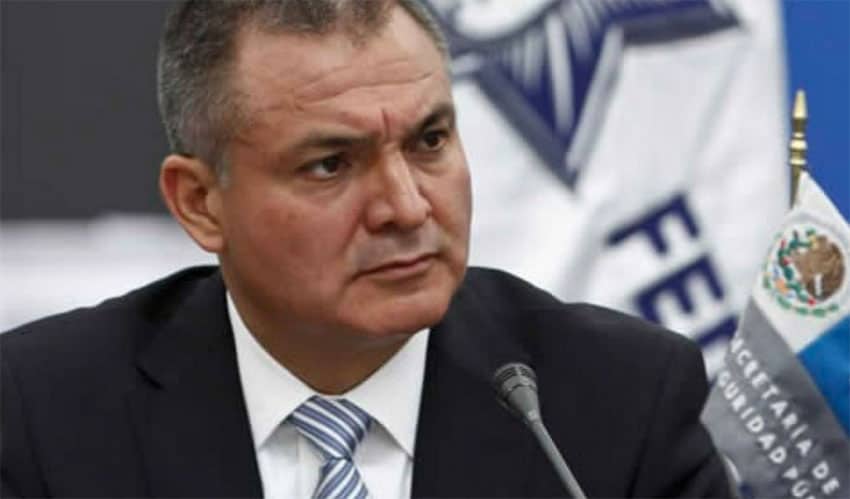
Former federal security secretary Genaro García Luna has pleaded not guilty to U.S. charges that he colluded with the Sinaloa Cartel in a drug trafficking conspiracy.
The nation’s head of security in the government of former president Felipe Calderón entered his plea on Friday during a brief appearance in federal court in Brooklyn, New York.
García, who led the so-called war on drugs launched by Calderón shortly after he took office in 2006, was indicted on December 4 by a grand jury in Brooklyn on charges that he allowed the Sinaloa Cartel to operate in exchange for multimillion-dollar bribes. He was detained in Dallas, Texas, on December 9.
The 51-year-old, who prior to serving as public security secretary headed up the now-defunct Federal Investigation Agency, allegedly provided the cartel with security that allowed it to freely move drugs to the northern border and supplied confidential information about government investigations and other criminal organizations.
The U.S. indictment said that Sinaloa Cartel bagmen personally delivered payments on two occasions to García using briefcases that contained between US $3 million and $5 million.
Former Sinaloa Cartel operations chief Jesús Zambada said at drug lord Joaquín “El Chapo” Guzmán’s New York trial last year that he personally gave García US $6 million in the mid-2000s.
United States prosecutors also said that the former official lied about his past criminal involvement when he applied for U.S. citizenship in 2018.

Dressed in khaki pants and a baggy gray sweatshirt, García appeared to be suffering from the strain of his almost month-long imprisonment during his 10-minute appearance in court, the newspaper Milenio reported.
His face was drawn and his demeanor submissive, Milenio said, noting also that he constantly turned around to look in the direction of his wife and two children who were seated in the second row of a packed courthouse.
García shook his head as the charges against him – three counts of cocaine-trafficking conspiracy and a false declarations charge – were read out by prosecutors.
Judge Peggy Kuo said he will remain in custody unless a court accepts a proposal for bail. Prosecutors said that they would oppose any such request because García’s wealth and alleged cartel links make him an extremely high flight risk.
Another procedural hearing was set for January 21 after which García will have a period of 70 days within which he may choose to change his plea. If convicted, García faces a prison sentence of between 10 years and life.
In Mexico, federal financial investigators are looking into the possible embezzlement of more than 4.8 billion pesos (US $250 million) in federal funds to companies with links to García. Former president Calderón has denied any knowledge of the alleged criminal activities of his security secretary.
President López Obrador, who blames Mexico’s ongoing violence problems on the security strategy first implemented by the Calderón administration, said on December 18 that his government wouldn’t investigate the ex-president in relation to the charges against his security secretary “because it would create the perception that we’re doing it for political purposes.”