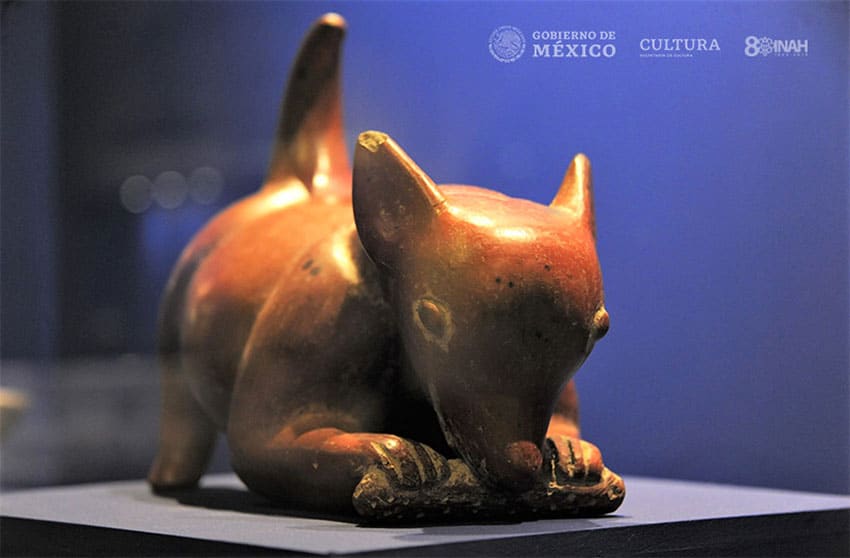
Mexico’s breeds of hairless dogs are the subject of an exhibition marking Day of the Dead festivities at Mexico City’s Museo de El Carmen.
The exhibition Xolos, compañeros de viaje (Xolos, Traveling Partners) displays 117 pre-Hispanic, artistic and artisanal pieces, as well as bones of extinct species, provided by over 20 institutions.
Visitors to the exhibition will see a panoramic presentation of the various breeds of hairless dogs endemic to Mexico that highlights their importance as part of the country’s cultural heritage.
“We Mexicans possess a special breed that is here despite all the problems that threatened its survival,” said Raúl Valadez Ursúa, an archaeozoologist at the National Autonomous University (UNAM).
He said the dogs have a troubled history, facing extermination policies during colonization and into the 19th century. He added that all breeds of hairless dogs in the Americas are endemic to Mexico.
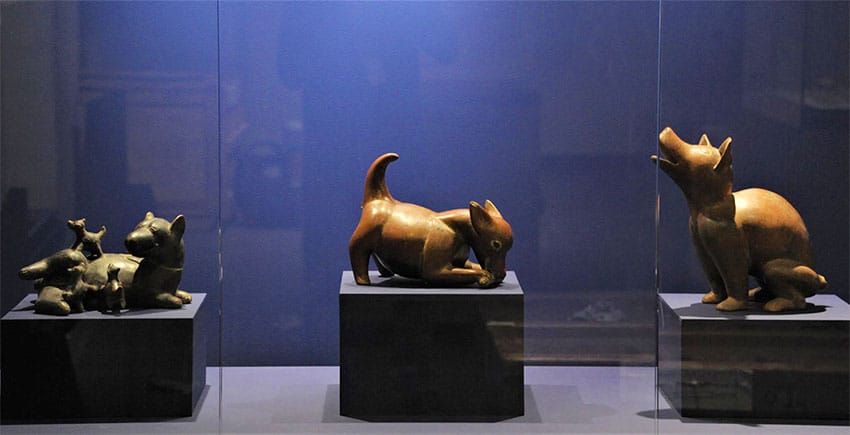
The exhibition explains the domestication of the dogs, their dispersion through the Americas and the presence of at least three Mexican hairless breeds: Xoloitzcuintles, Tlalchichis and Itzcuintles; the latter two of which are now extinct.
Visitors are welcomed to the exhibit by Cipactli, a taxidermically preserved specimen of Xoloitzcuintle that was a model for artists and won many prizes during its lifetime. Cipactli gazes at the bones of what was most likely an Itzcuintle.

More commonly known as the “Dogs of Colima,” the extinct Tlalchichis were immortalized in the red clay pottery from the Comala phase (200-500 AD), much of which is on display in the exhibition.
Pieces unearthed at Mexico City’s Templo Mayor highlight the relevance of Xólotl, the Aztec god who was believed to accompany the dead on their journeys to Mictlán, the Aztec underworld.
A brief but fundamental display tells of the disappearance of these dogs until very recently. The extinct breeds are known to modernity only through codices and historical texts, such as Fray Bernardino de Sahagún’s General History of the Things of New Spain.
The Xoloitzcuintle regained popularity in the 20th century, primarily as a source of inspiration for artists such as Frida Kahlo, Diego Rivera and Francisco Toledo.
Xolos, compañeros de viaje will be on display until April 2020, after which it will be moved to the Regional History Museum of Colima.
Mexico News Daily