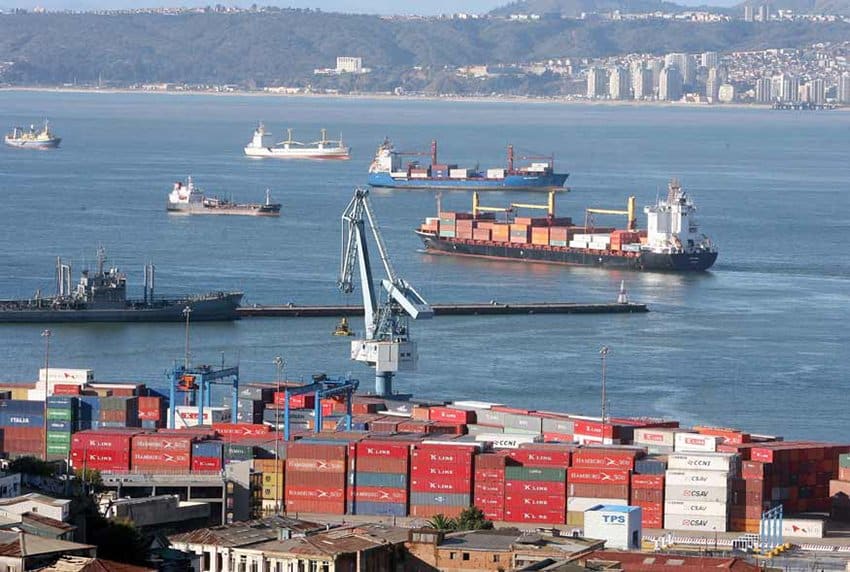
The federal government’s anti-fuel theft strategy has not only stranded motorists unable to buy gasoline but ships as well: at least 60 oil tankers are stranded at Mexico’s principal ports, unable to unload their fuel.
According to ship tracking website Marine Traffic, the tankers are stuck at the ports of Tuxpan, Veracruz, Altamira, Acapulco, Coatzacoalcos, Lázaro Cárdenas, Manzanillo, Salina Cruz, Tampico, Mazatlán, Guaymas, La Paz, Ensenada and Campeche.
Two-thirds of the stranded tankers are located at just two Gulf of Mexico ports — Veracruz, where 31 are waiting to unload, and Tuxpan, where there are nine.
Shipping experts told the newspaper Milenio that the tankers are unable to unload their cargo because port storage facilities are full due to the closure of petroleum pipelines.
As part of the strategy to combat fuel theft, the government is making greater use of tanker trucks to transport fuel rather than pipelines, a move that has caused gasoline shortages in at least 10 states.
“. . . Right now, all [the storage facilities] are full, by orders of our president the pipelines are shut, that’s all we know at the moment,” said Guillermo Pancardo, a state oil company employee.
Milenio confirmed that nine oil tankers at the port of Tuxpan, Veracruz, are currently unable to unload their fuel.

Port officials said that one of the ships, Tambourin, has been waiting to offload its cargo for 41 days.
In total, the officials said, there are 315,000 tonnes of fuel waiting to be unloaded at Tuxpan so that it can be distributed to different parts of the country.
The congestion problem at the port, located about 300 kilometers north of Veracruz, is set to get worse, with a Singaporean tanker expected to arrive tomorrow from Texas and a Greek ship expected Sunday from Louisiana.
The pipeline between Tuxpan and Mexico City is currently closed because, according to President López Obrador, it has been damaged by repeated acts of sabotage.
Gonzalo Monrroy, manager of energy consultancy GMEC, said that a single oil tanker carries between 350,000 and 400,000 barrels of fuel and costs between US $30,000 and $50,000 a day to operate, even if it is inactive.
“Part of this bottleneck is due to Pemex, the closure of pipelines . . . [Fuel] inventory levels are becoming increasingly worrying, it’s an issue that Pemex and the Secretariat of Energy have to resolve quickly,” he said.
But federal Energy Secretary Rocio Nahle denied yesterday that there is a problem at the nation’s ports.
“We are not aware of an issue in the unloading of gasoline . . .” she said.
However, López Obrador accepted that there are tankers “waiting” at some ports but he rejected the claim that they are stranded.
“It’s only in Coatzacoalcos and Tuxpan,” the president told reporters yesterday.
Asked whether the tankers are stranded, López Obrador responded: “No, not necessarily, there is a lot of invalid, false information . . . ”
At his daily press conference this morning, the president pledged that the situation at Mexico’s ports and gas stations would return to normal soon.
“. . . Unfortunately, we’re buying 600,000 barrels [of gasoline] a day . . .Ships are constantly coming into the maritime terminals . . . That’s why I say that we don’t have a gasoline shortage problem, we have gasoline to last a long time. The only issue is one of distribution to the interior of the country due to sabotage of the pipelines and the decision to no longer allow the theft of fuel.”
Source: Milenio (sp)