Mexico is planning to impose new tariffs on United States imports in April in order to pressure U.S. lawmakers to remove duties on Mexican steel and aluminum.
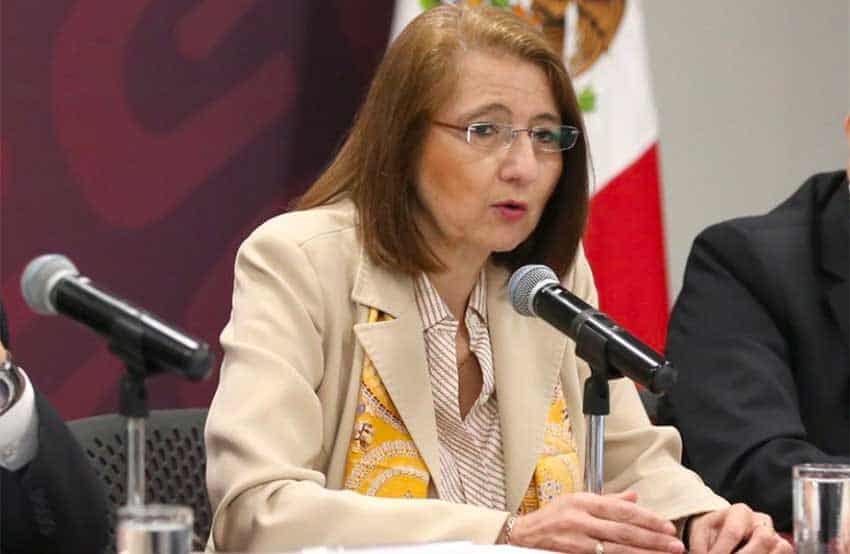
Foreign trade undersecretary Luz María de la Mora told the Senate this week that the Secretariat of Economy (SE) is preparing a new list of products to which tariffs of between 7% and 25% will apply.
“We’re carrying out an evaluation of the products that we believe should be on the retaliation list and yes, we believe that we can adjust some products to respond to some of the new representatives who are in the United States Congress,” de la Mora said.
Mexico struck back swiftly after the United States announced last May that it was introducing tariffs of 25% on steel and 10% on aluminum as of June 1 on national security grounds.
Reciprocal duties targeted a range of U.S. products including steel flats, pork, apples, some cheeses and bourbon.
Many of the goods subjected to Mexican tariffs were chosen because they are produced in large quantities in U.S. states that were politically important to President Donald Trump in last November’s midterm elections.
Despite the imposition of tit-for-tat tariffs and the resultant trade tensions, Mexico, the United States and Canada signed a new trilateral trade agreement on November 30 after contentious negotiations that lasted more than a year.

Once ratified by the legislatures of the respective countries, the pact will replace the 25-year-old NAFTA.
The day after the United States-Mexico-Canada Agreement (USMCA) was signed, Andrés Manuel López Obrador was sworn in as president and members of his administration almost immediately began advocating for a tougher response to the United States Section 232 metal tariffs.
“Eliminating [the tariffs] is urgent, in reality it’s very regrettable that we signed [the new trade pact] without them having been removed,” Jesús Seade, foreign affairs undersecretary for North America, said in the new government’s first week in office.
“We should have pushed harder. Now that we have entered [government] we have to push very hard on this matter and I hope that will happen in the first weeks of the new regime . . .”
De la Mora told senators Wednesday that before the USMCA can be considered for ratification by Mexico’s Congress, the metal tariffs “must be eliminated” because they are “contrary to the productive integration” of the North American market.
The statement reiterated earlier statements by de la Mora and other trade officials that the deal won’t be ratified unless the United States withdraws the metal tariffs.
Under the terms of the USMCA, Mexico is required to make changes to its labor laws to improve the rights and conditions of workers.
High-wage zones where automotive sector workers earn at least US $16 per hour will also have to be established in order to comply with stricter rules of origin.
De la Mora said in an interview that the government wants to have a labor reform package approved by Congress by the end of April “so we can reflect the commitments we have made under the new U.S.-Mexico-Canada agreement in domestic legislation.”
However, she stressed that the government would have moved to improve workers’ rights even if the new trade pact didn’t demand it.
“With the agreement or without the agreement, this is something central to President López Obrador – strengthening workers’ rights and strengthening trade deals in Mexico,” de la Mora said.
She indicated that while Mexico agreed to the terms of the USMCA, the government isn’t desperate for it to take effect.
“We hope to have this new agreement in place. But in the absence of the new agreement, we know that NAFTA is good enough,” de la Mora said.
Two ruling party senators expressed similar sentiments earlier this week.
“We are going to approve it, but right now our government is trying to deal with this [the metal tariffs],” said Antares Guadalupe on the sidelines of a conference in Ottawa, Canada.
“We’re not in a rush. Trade right now, it’s working. We have many things to do but we want to take it slowly because it is very important to have it in a very good way for Mexico.”
Asked what would happen if the USMCA is not ratified, the president of the Senate’s foreign affairs committee laughed.
“Life goes on, I assure you,” Héctor Vasconcelos said. “[NAFTA is] good enough and we will try to get it better. That’s what we are going to do. We have to discuss a lot in Mexico.”
Source: El Economista (sp), Aluminium Insider (en)