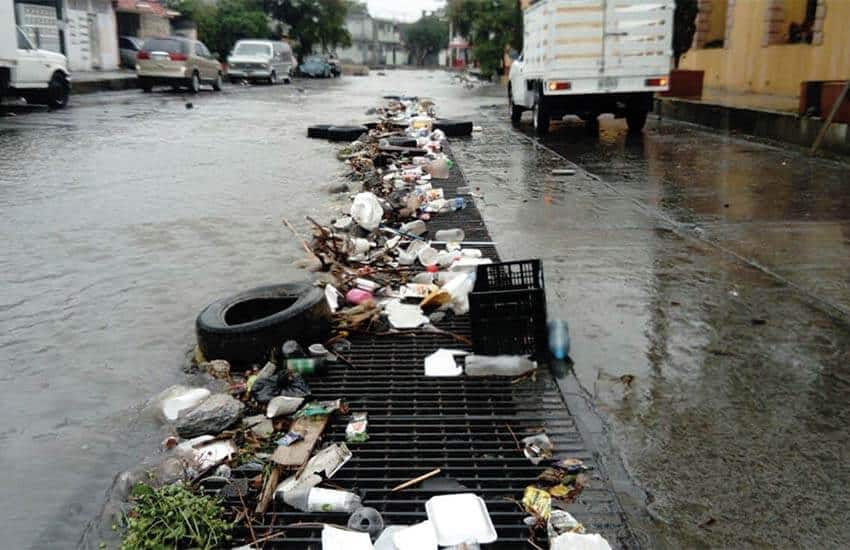
Massive quantities of trash collected in CDMX flood-prevention measure

Garbage collectors have removed a huge quantity of trash from Mexico City dams, drains and streets over the past four months as authorities aim to mitigate flooding during the rainy season.

Guillermo Ayala, an official with the Mexico City Risk Management and Civil Protection Ministry, said that almost 182,000 cubic meters of trash have been removed from 121 key locations.

The newspaper Reforma reported that the quantity is sufficient to completely fill Estadio Azteca, the huge soccer stadium on the capital’s south side.

Ayala said that the accumulation of trash – which frequently clogs drains – is “the main and only reason” for flooding in the capital. The problem is particularly bad in Mexico City’s most densely populated areas, he said, apparently referring to boroughs such as Iztapalapa and Gustavo A. Madero.

Littering – including the disposal of refuse by businesses, especially those with street stalls – is the main cause of the problem, which appears to be getting worse. The quantity of garbage collected between February and June was 57% higher than in the same period of last year.

Ayala said that the amount of trash has increased this year because there are more people on the street due to the decline of the pandemic. He also said that there were fewer workers to collect trash in 2020 and 2021 due to high levels of absenteeism associated with the pandemic.

One of the locations where massive quantities of rubbish accumulate is on Zaragoza Road near the Santa Martha Acatitla women’s prison in Iztapalapa.

Ayala said that 25 tonnes of trash were collected there in one 36-hour period. He blamed heavy foot traffic and the presence of a tianguis, or open-air market, for the large amount of litter.

Flooding is common in parts of Mexico City during the rainy season, which usually starts in late May or early June and concludes in October.

A massive drainage tunnel was built to reduce flooding, but inundations in the capital will likely remain an annual occurrence as long as people continue to litter.

With reports from Reforma 

Have something to say? Paid Subscribers get all access to make & read comments.
Manzanillo, Colima, México, 13 de marzo de 2026. La doctora Claudia Sheinbaum Pardo, presidenta Constitucional de los Estados Unidos Mexicanos en conferencia de prensa matutina, “Conferencia del Pueblo” desde Colima. La acompañan Indira Vizcaíno Silva, gobernadora Constitucional del Estado de Colima; Omar García Harfuch, secretario de Seguridad y Protección Ciudadana (SSPC); Raymundo Pedro Morales Ángeles, secretario de Marina (Semar); Bulmaro Juárez Pérez, divulgador de lenguas originarias, presentador de la sección “Suave Patria”; Ricardo Trevilla Trejo, secretario de la Defensa Nacional (Sedena); Jesús Antonio Esteva Medina, secretario de Infraestructura, Comunicaciones y Transportes; Bryant Alejandro García Ramírez, fiscal general del Estado de Colima; Fabián Ricardo Gómez Calcáneo; Rocío Bárcena Molina, subsecretaria de Desarrollo Democrático, Participación Social y Asuntos Religiosos de la Secretaría de Gobernación; Efraín Morales López, director general de la Comisión Nacional del Agua (Conagua); Marcela Figueroa Franco, secretaria ejecutiva del Sistema Nacional de Seguridad Pública (SESNSP) y Guillermo Briseño Lobera, comandante de la Guardia Nacional (GN). Foto: Saúl López / Presidencia

Mexico’s week in review: Congress deals Sheinbaum her first legislative defeat

0
The week of March 9 in Mexico was marked by standoffs between allies in Congress and adversaries at the airport. Here's what you missed.
A soldier displays seized handguns

The US and Mexico, growing together and growing apart: A perspective from our CEO

1
From a historic drop in homicides to opposite bets on electric vehicles, Mexico News Daily's CEO breaks down where the U.S. and Mexico are converging — and where they're not.
Veracruz Gov.

Veracruz governor blames private vessel for 200-kilometer Gulf Coast oil spill

1
The spill, which has spread to over 200 kilometers of Mexico's Gulf Coast beaches, has been traced to a private oil tanker off the coast of Tabasco.
BETA Version - Powered by Perplexity