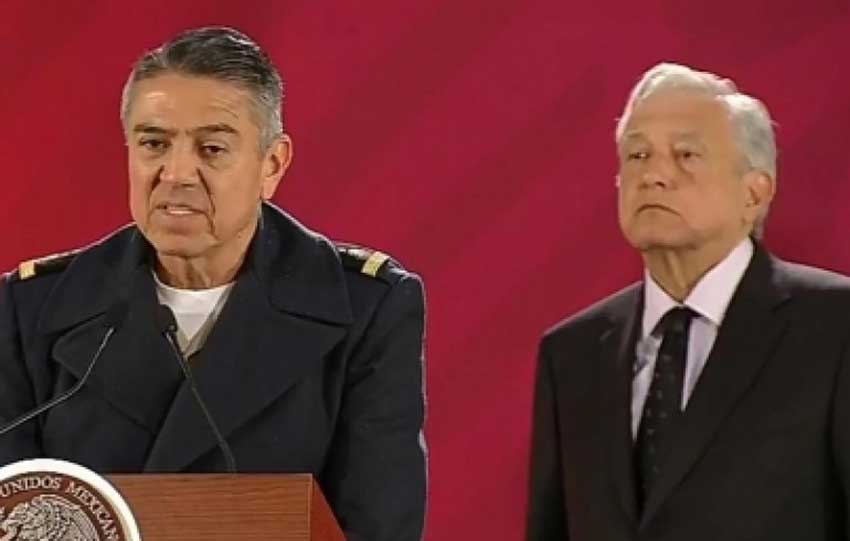
The average quantity of fuel stolen on a daily basis has fallen from 80,000 barrels in November to 2,500 barrels this month, according to the army general in charge of the deployment to protect Mexico’s petroleum pipelines.
After measures were implemented to combat fuel theft in December, Arturo Velázquez Bravo said, the amount of fuel stolen declined from 80,000 barrels per day in November to an initial 40,000 barrels, after which it decreased further to 30,000 and then reached historical figures of 2,500 barrels.
“From 80,000 [barrels] to 2,500 is an enormous difference,” Velázquez added.
The general said the government’s decision to deploy the military to protect fuel infrastructure has been effective in combatting fuel theft although he conceded that the strategy “hasn’t been all hunky-dory.”
A clash between soldiers and suspected fuel thieves in Hidalgo Sunday resulted in the death of a civilian while four Federal Police officers were wounded in another confrontation with presumed huachicoleros, as the thieves are known, in Puebla last night.
One of the officers later died in a Mexico City hospital, the federal Security Secretariat said today.
Velázquez said that just over 5,000 members of the army, navy and Federal Police have been deployed to protect five petroleum pipelines across Mexico.

“The country has approximately 56,000 kilometers of [petroleum] pipelines, of which we consider 13,000 kilometers problematic and 6,000 [kilometers] critical . . .” he said.
As part of the strategy to combat fuel theft, the state oil company has been making greater use of tanker trucks to transport fuel rather than pipelines, a move that has caused gasoline shortages in more than 10 states.
Source: El Universal (sp), Milenio (sp)