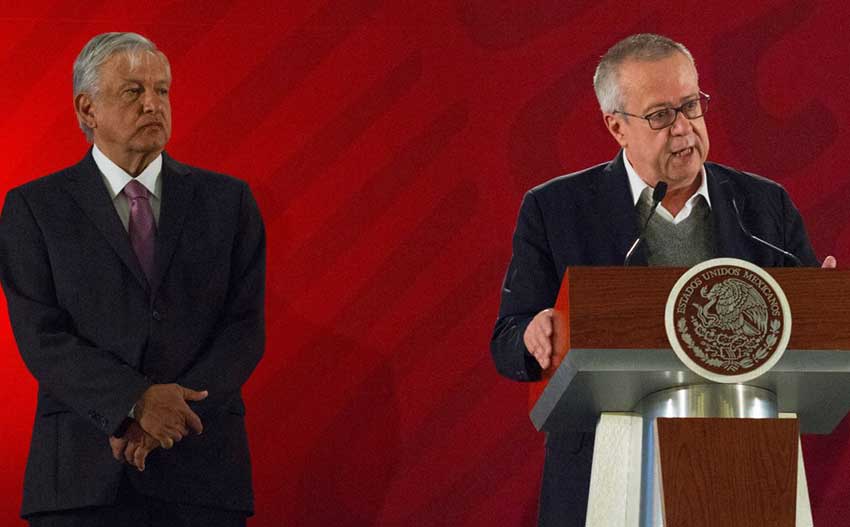
President López Obrador presented today a 107-billion-peso (US $5.5-billion) rescue plan for Pemex aimed at reducing the state oil company’s financial burden and strengthening its capacity to invest in exploration and production.
“We’ve taken the decision to support Pemex with everything,” López Obrador declared at his morning press conference, explaining that making the company profitable and productive was the great challenge of his government.
To that end, López Obrador said that the state-run company will receive a cash injection, its tax burden will be reduced and it will be cleansed of corruption.
The cause of many of Pemex’s problems is corruption, the president charged, especially dwindling oil production.
He described the rescue package, which is divided into four parts, as “an initial plan,” explaining that “if they require more, there will be more support.”
Pemex finance chief Alberto Velázquez explained that there will be a 25-billion-peso (US $1.3-billion) cash injection into the company and pledged that Pemex won’t take on new debt in 2019.
He said the second rescue measure consists of a plan to transfer 35 billion pesos (US $1.8 billion) from the Secretariat of Finance and Public Credit (SHCP) as an early payment of a debt the latter has with the former.

The company will be given a tax break of at least 15 billion pesos (US $800,000) this year, Velázquez said, explaining that its tax burden will be further reduced during the government’s six-year term and that the saving could be as much as 30 billion pesos next year.
Finally, an estimated 32 billion pesos (US $1.6 billion) in savings generated by the government’s crackdown on fuel theft will also be directed to Pemex.
Speaking after the rescue plan was presented, Finance Secretary Carlos Urzúa stressed that the government is committed to supporting Pemex, whose debt of more than US $100 billion makes it the most indebted oil company in the world.
“. . . The federal government, through the Secretariat of Finance, will do whatever it can to maintain Pemex’s finances healthy,” he said.
Reuters reported that investors were reassured by the announcement although they had expected stronger measures. “The announcement is positive and could be enough to remedy the company’s additional financial needs for 2019,” said Edgar Cruz, global markets credit research at BBVA in Mexico, while warning that it would not stave off another crunch next year.
The company must make more than $27 billion in debt payments over the next three years.
Fitch downgraded Pemex’s credit rating to just one level above junk last month, a move that was slammed by López Obrador, who accused rating agencies of hypocrisy because “they maintained a complicit silence” during the past government and “endorsed the so-called energy reform” even though “they knew that foreign investment didn’t arrive and investment in Pemex didn’t increase.”
The president said today that with the announcement of the government’s rescue package, including his pledge to stamp out corruption in Pemex, the ratings agencies will now “treat us well.”
He explained: “They have all the information, especially about corruption issues. They know very well what was happening in Pemex and the CFE [the Federal Electricity Commission].”
Source: El Economista (sp), El Financiero (sp), Reuters (en)