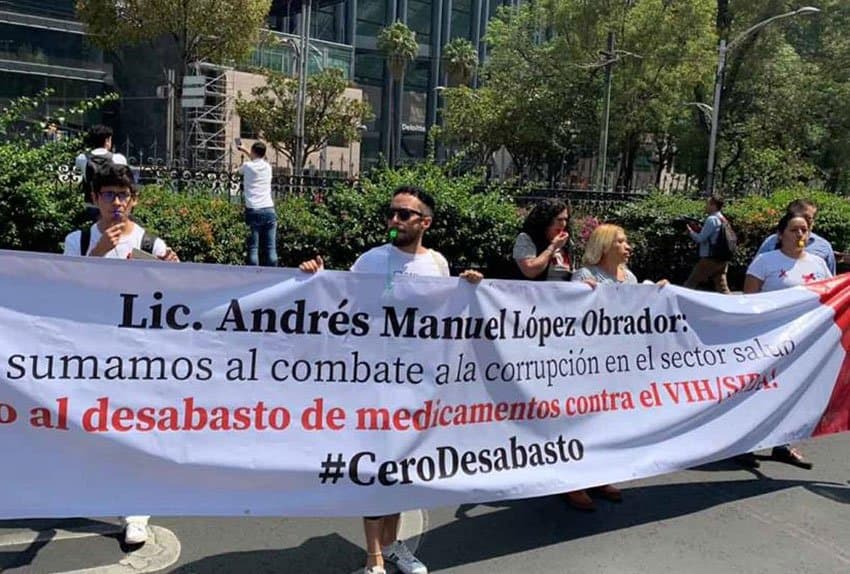
Public hospitals and healthcare clinics continue to face medicine shortages, according to a pharmaceutical industry leader who also says the federal government hasn’t considered the logistics and costs of distributing the drugs it plans to purchase in 2020.
Hospitals in at least 24 states reported shortages of medicines last month and the problem still “hasn’t been controlled,” said Rafael Gual Cosío, head of the National Chamber of the Pharmaceutical Industry (Canifarma).
“It continues because the federal government stopped buying,” he said, explaining that the current administration has only purchased 20% of the medicines its predecessor committed to for 2019.
“[The government] should have bought 50% of what was agreed to [by now] . . . but it’s not more than 20% on average. It stopped buying and that’s why there’s a shortage,” Gual added.
To avoid a crisis in the health sector, the Canifarma chief said, the full order placed in November needs to be “reactivated” although he conceded that the pharmaceutical companies contracted to produce the drugs may not have the raw materials to do so.
“If they don’t, we’ll have to wait at least three months [for new medicines],” he said.
The government is currently preparing its 2020 medicine order but according to Gual, preparation of the new tender is delayed and it doesn’t consider the cost of distribution.

At the conclusion of its six-year term, the previous government awarded contracts to three logistics operators to store and distribute the 35 billion pesos (US $1.8 billion) worth of medicine it committed to purchasing this year.
However, the new government announced that the Mexican Social Security Institute (IMSS) would take on that responsibility.
But Gual argues that neither IMSS nor any other government department, including the army, has the capacity to adequately store and transport the massive quantities of drugs required by patients in the public health system.
“. . . It’s humanly impossible . . .” he said. “The government didn’t calculate the volumes [of drugs that have to be stored and transported] . . . The current [2020] tender is madness . . .”
The industry representative said that Canifarma personnel have met with government officials to express their concern about its future plans and to seek solutions to the current medicine shortages but has only found “great ignorance of the industry and its operation.”
He pointed out that the Secretariat of Health has taken over responsibility for ordering medicine from the Secretariat of Finance but claimed that “they don’t know what to do” to resolve the current situation.
Gual said that in 38 years working in the industry, he has never seen a medicine shortage as bad as what the nation is currently facing.
“To deal with the shortage, we have to take advantage of what we have,” he said, referring to the previous government’s tender.
The Canifarma chief also said that time is running out to prepare and submit the 2020 medicine order, warning that if it doesn’t adequately anticipate medicine needs for 2020, the government’s logistical limitations will make it difficult for imports to make up the shortfall.
“They’ll face the same distribution problem. The medicines arrive at [the port of] Manzanillo and then what? Who’s going to take them to the 2,000 points [public health facilities]. There’s no way [to do it].”
Source: Milenio (sp)