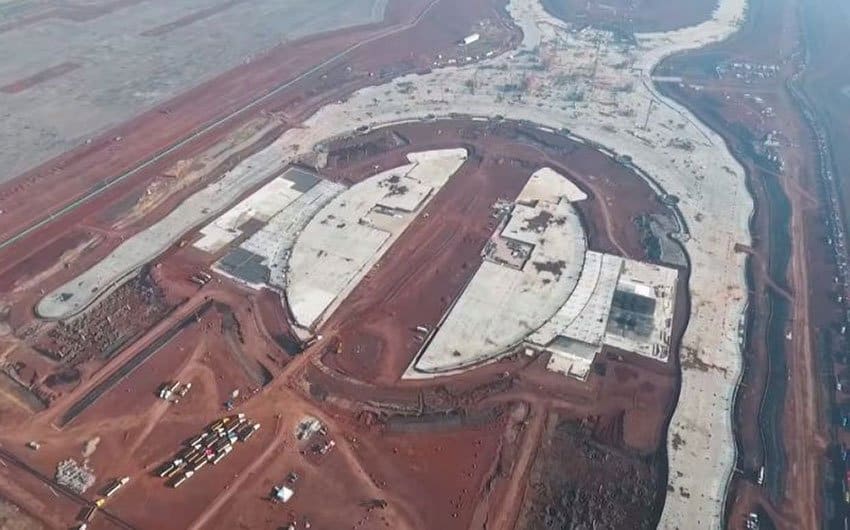
The federal government sweetened its buyback offer this week for bonds issued for the cancelled Mexico City airport project but investors once again rejected it, although they said it was an improvement on last week’s proposal.
The Secretariat of Finance presented the new offer Tuesday, increasing the repurchase price for US $1.8 billion in bonds from US $900 for US $1,000 invested to an even US $1,000 plus accrued and unpaid interest.
It also said that a consent payment would be made to investors who agree to the deal by December 19.
The offer, which closes on January 4, also added a new default trigger if any new airport begins operations within a 70-kilometer radius of Mexico City’s existing airport.
The offer was well received by bond markets with the US $3-billion bond due in 2047 spiking to as high as 93 cents to the dollar yesterday compared to 83 cents after the original December 3 offer.
But an ad hoc group representing holders of bonds worth more than half the US $6 billion in debt issued by the Mexico City Airport Trust (MexCAT) to partially fund the now-scrapped US $13-billion project said in a statement yesterday that while “the amended proposal makes incremental improvements, fundamental problems . . . .”
It also objected to a new timetable that is half that of the original proposal issued on December 3, suggesting that the early-tender deadline should be extended to at least December 21.

The group, represented by international law firm Hogan Lovells, claimed that it was not consulted on the amended offer.
President López Obrador confirmed at the end of October that the airport project at Texcoco, México state, would be scrapped after a four-day public consultation found 70% support to kill it.
Instead, the Santa Lucía Airforce Base in México state is to be converted for commercial aviation use and the existing Mexico City airport and that in Toluca will be upgraded.
Deputy finance secretary Arturo Herrera told reporters after this week’s offer was made that the bonds were to be repaid via funds collected in passenger taxes and that the default clause was designed to ensure that there would be enough passenger revenue to do so even with a multi-airport system in operation.
But the ad hoc group of bondholders said that the new proposal’s terms “are insufficient to compensate for the reduction or complete elimination of passenger volume at the [Mexico City] Benito Juárez airport to be expected over time as a result of the opening of such alternative airports.”
It argued that without “additional collateral (such as from alternative airports or otherwise) to compensate for the removal of the originally agreed Texcoco collateral protection, bondholders remain without effective substitute sources of payment.”
The statement concluded by saying that “the Ad Hoc Bondholder Group, consisting of a group of large international investment institutions, still desires, and looks forward to, discussing its concerns and proposed resolutions with MexCAT.”
Mario Castro, an economist and vice-president at Nomura Securities, said “the new deal shows a willingness to negotiate by the Mexican government and will likely prevent a further deterioration of sentiment, but it doesn’t fix the damage that was done by the initial cancellation of the airport.”
Source: El Financiero (sp), Financial Times (en)