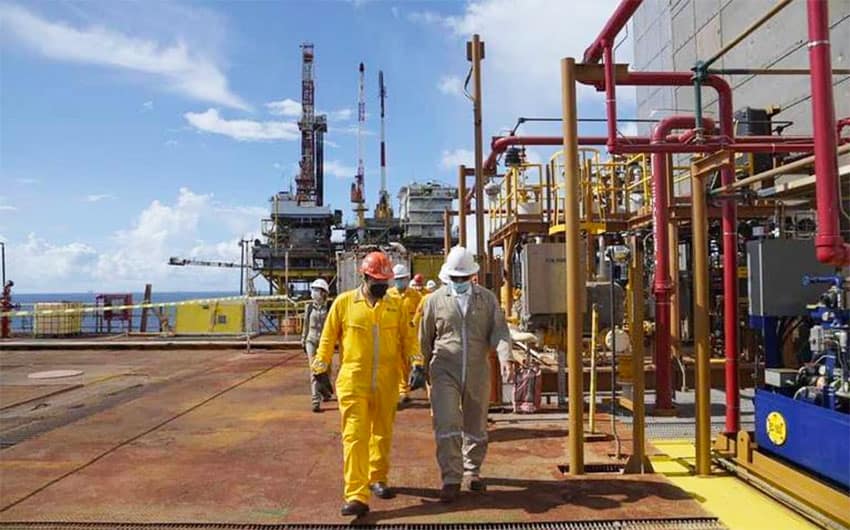
The federal government is forging ahead with its plans to increase state control in Mexico’s energy sector, which was opened up to private and foreign companies by a 2014 reform.
President López Obrador, a staunch energy nationalist and fierce critic of the reform, sent a proposal to Congress on Friday to alter the federal Hydrocarbons Law, which governs activities in the oil sector.
With an argument based on safeguarding national security, energy security and the national economy, AMLO, as the president is commonly known, is proposing that the federal government have the authority to suspend permits granted to private companies that operate in any part of the oil industry chain including production, processing, storage, transportation, sales to the public, importation and exportation.
All permits granted by the Energy Ministry (Sener) and the Energy Regulatory Commission (CRE) to private firms that operate in the Mexican oil sector would be subject to suspension in case of “imminent danger to national security, energy security or the national economy,” according to the initiative sent to Congress.
It was unclear how “imminent danger” would be defined.
The proposed reform, which would benefit the state-owned oil company Pemex, comes after the passing of legislation that gives power generated by the Federal Electricity Commission (CFE) priority on the national grid over that produced by private and renewable energy companies.
However, the Electricity Industry Law, and the government’s energy reliability policy which also favored the state-owned CFE, have both been struck down by courts after they were challenged by private companies that have invested heavily in Mexico since the 2014 energy reform took effect.

The legal challenges haven’t dissuaded López Obrador from pursuing his quest to “rescue” Pemex and the CFE from what he describes as years of neglect and give them greater control of the energy sector. Just last week, the president said he was prepared to send a bill to Congress to change the constitution if the new electricity law is deemed unconstitutional.
While that law aims to bolster the CFE by relegating private firms in the power supply pecking order, the objective of the proposal to change the Hydrocarbons Law is to expropriate private oil sector interests, according to one energy expert.
Gonzalo Monroy, a Mexico City-based energy analyst, said on Twitter that he had read and analyzed AMLO’s proposal and reached the conclusion that the aim is expropriation.
“Once and for all I’ll put it on the table: THEY WANT TO EXPROPRIATE – direct expropriation – by taking the place of owners and operators … of everything related to fuels,” he wrote.
“A detail: not just fuels but ALL hydrocarbons and ALL petrochemical products,” Monroy said in a subsequent tweet.
The Mexican Institute for Competitiveness (Imco), a think tank, was also critical of López Obrador’s proposal.
“If it’s approved, this initiative will have negative implications for competitiveness,” Imco said on Twitter, noting that Sener and the CRE could suspend permits granted to private companies if they – “in their judgement” – represent a danger to security or the economy.
“[AMLO’s proposal] also says that Pemex could take over the administration and operation of installations of companies whose permits have been suspended and make use of their personnel, which would represent an act of direct expropriation,” the think tank said.
“… This initiative is presented at a time at which national and foreign investors are questioning the energy policy decisions of the current administration within the framework of the recently approved reform to the Electricity Industry Law,” Imco noted.
The global consulting firm Kearney this week cited the government’s energy sector measures as a major reason Mexico wasn’t included on its 2021 index of the 25 most attractive countries in the world for foreign investors.
Source: El Universal (sp)