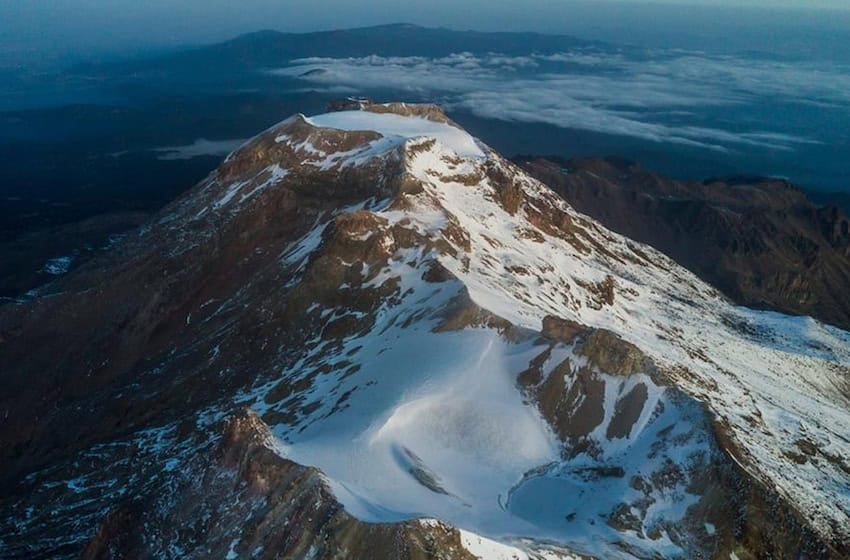
Mexico has lost about 80% of its glacial cover since the 1960s, according to a study conducted by UNESCO.
The news was revealed during the presentation of the 2025 edition of the United Nations World Water Development Report. During the event, Laura Verónica Imburguia, member of the UNESCO World Water Assessment Programme (WWAP), said that Mexico’s situation is “alarming” due to its direct impact on water supply and ecosystem stability.
“Mountains and glaciers are the world’s water towers, sustaining the lives of a billion people downstream,” she said, adding that the situation is concerning in all of Latin America, a region that generates more water per unit area than any other in the world.
Imburguia said that many glaciers have disappeared or are in the process of disappearing, which is already affecting high-value agricultural production like coffee and cocoa, and hydroelectric power generation.
Which mountains have glaciers in Mexico?
These are the mountains in Mexico that have – or used to have – glaciers.
Pico de Orizaba (Citlaltépetl), at 5,636 meters between the states of Veracruz and Puebla, is the mountain with the greatest number of glaciers in Mexico. However, it has lost nearly 80% of its glaciers: it used to have 204 glaciers, and now only 37 remain.
Iztaccíhuatl, located at an elevation of 5,230 meters between the states of Puebla and Mexico, once had 12 permanent ice masses that covered approximately 120 hectares. Currently, it has only about 10% of its original glaciers and is at risk of losing the remaining ice within a few years.

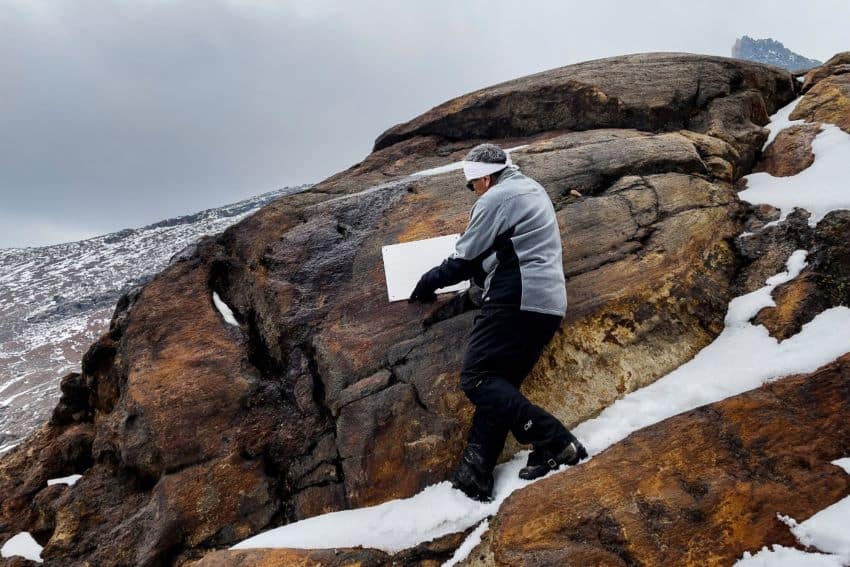
Popocatépetl, located at just over 5,400 meters between the states of Morelos, Puebla and México state, has lost all its glaciers due to global warming and volcanic activity.
Currently, the lower limit of glacial ice in Mexico is around 5,100 meters. For reference, 65 years ago, it was between 4,600 and 4,700 meters. This means that, previously, a hiker could find glaciers at lower altitudes, whereas now they must climb much higher to reach them.
The National Autonomous University of Mexico (UNAM) has said that the remaining glaciers could completely disappear within the next five years.
How does the disappearance of glaciers affect Mexico?
While Mexico’s glaciers are small compared to other regions, their disappearance could have serious consequences for the local environment.
Communities near these mountains depend on seasonal snowmelt to feed rivers, streams and springs. As these sources dwindle, pressure increases on other water reserves, such as reservoirs and aquifers, many of which are already overexploited.
Furthermore, glaciers play a vital ecological role: they regulate the temperature and humidity of high-mountain ecosystems and stabilize watersheds. Their disappearance disrupts these dynamics and endangers endemic species that depend on these conditions.
Environmental experts at UNAM have said that halting global warming is the only effective strategy to prevent the complete disappearance of Mexican glaciers. This can be achieved by reducing greenhouse gas emissions, legally protecting natural areas in high mountains and boosting environmental education.
With reports from Excelsior