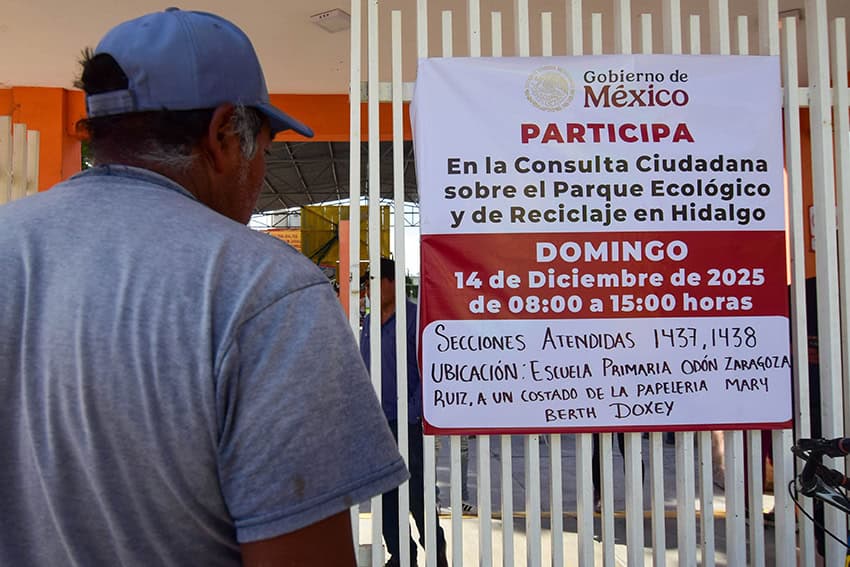
Residents of the Mezquital Valley north of Mexico City rejected plans to build a recycling plant that the government had labeled “an act of justice” for the state of Hidalgo.
Fewer than 9% of registered voters participated in last Sunday’s public referendum, in which 63% voted against the government’s Circular Economy Park project. President Claudia Sheinbaum quickly announced that her administration would look for another site to develop the plant.
🗳️ La #ConsultaCiudadana para el Parque Ecológico y de Reciclaje de Hidalgo, se llevó a cabo el día de hoy, domingo 14 de diciembre, para conocer la postura de los habitantes en las regiones de Tula, Atitalaquia y Tlaxcoapan:
🔗https://t.co/ovbZVNHfXQ pic.twitter.com/LC3Lh9Z1aZ— El Sol de Hidalgo (@ElSoldeHgo) December 15, 2025
“We will always respect the will of the people,” she said on Monday, adding that “this referendum reaffirms the democratic conviction of the Fourth Transformation, whose motto is ‘with the people everything, without the people nothing.’”
With much fanfare, Sheinbaum had announced plans for Mexico’s first Circular Economy Development Hub for Well-being (Podecibi) in September, promising to gradually eliminate 450 open dumps, benefiting the more than 600,000 inhabitants of the Hidalgo municipalities of Tula de Allende, Atitalaquia and Tlaxcoapan.

With development slated to begin in January, the federal government had set aside 1.72 billion pesos (US $95.7 million) for the project — 1.3 billion pesos for a recycling plant for reusing solid waste and 420 million pesos for an environmental park.
Congress approved a new General Law on Circular Economy on Dec. 10, as part of a growing commitment to keep materials and products in circulation rather than the traditional use-and-discard approach. All that was then needed was public approval, setting the stage for Sunday’s referendum.
The Environment Ministry and the state government spearheaded an aggressive “Vote Yes” campaign, featuring ads blaming previous “neoliberal” governments for turning the Tula-Atitalaquia region into a “sacrifice zone” — that is, a geographic area that suffers disproportionate environmental harm from industrial activities for the economic benefit of others.
And indeed, the region was declared a sacrifice zone in 2019 due to high levels of pollution in the soil, air and water caused by the presence of thermoelectric plants, refineries and more than 300 industries.
However, opponents of the project blasted the government for a lack of transparency and claimed the government’s propaganda campaign was misleading, emphasizing that the authorities had yet to conduct an environmental impact study as required by law.
Greenpeace México denounced ads that declared it approved the plan, issuing a public statement saying representatives had attended one informational meeting but had never expressed support.
In a Dec. 11 social media post, Greenpeace México said it rejected the project — which included the burning of plastic waste and tires via a process known as pyrolysis, which can generate highly toxic compounds and hazardous waste — and criticized the government’s failure to include the public in the decision-making process.
Environmental groups also criticized the new circular economy law, saying Congress relied solely on input from industry, refusing to involve civil society in the truncated approval process which did not include deliberations in legislative committees. Activists also decried the fact that much of the action depends on self-regulation within the industry itself.
On Sunday, participants were asked to respond to this question: “Every person has the right to a healthy environment for their development and well-being. Do you agree with the construction of the Ecological and Recycling Park in Hidalgo to expand green areas, reduce garbage dumps and decrease the pollution they generate?”
The end result? Nearly two-thirds (63.1%) of the 12,259 people who participated voted against the project with residents of the municipalities of Atitalaquia and Tlaxcoapan overwhelmingly rejecting the plan.
With reports from El País and Animal Político