The number of regions considered security priorities for the federal government due to their high levels of violent crime has been increased to 45.
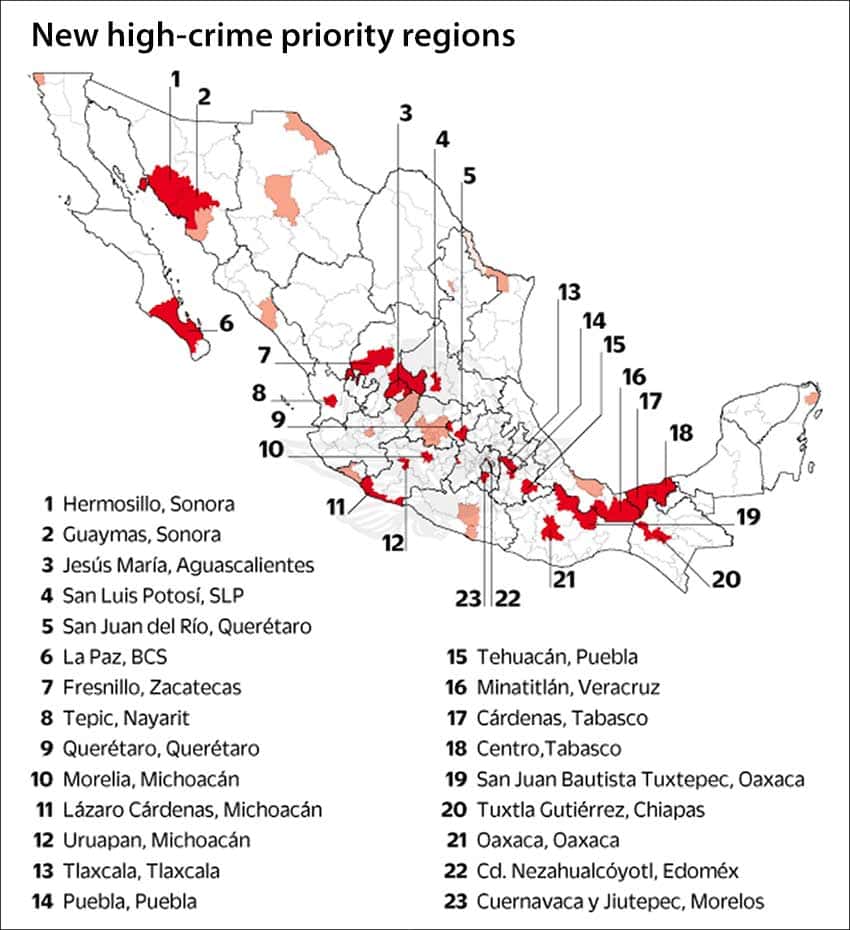
The Security Secretariat (SSPC) yesterday added 24 locations in 16 different states to the list of those considered the most violent in the country.
Among the newly-designated regions are Cuernavaca, Morelos; Morelia, Uruapan and Lázaro Cárdenas in Michoacán; Oaxaca city; Hermosillo, Sonora; Ciudad Nezahualcóyotl, México state; Querétaro city; San Luis Potosí city; La Paz, Baja California Sur; Fresnillo, Zacatecas; Tlaxcala city; Puebla city; and Villahermosa, Tabasco.
However, security in the 24 regions will not be bolstered immediately.
Security Secretary Alfonso Durazo estimated that it will be towards the end of the year before additional federal security personnel, including members of the National Guard, can be deployed in the different areas.
“. . . At the moment, we don’t have the necessary security personnel to cover them in the way in which we are already responding to the [other] 21 priority regions,” he said.
Among the cities that have already received additional deployments are Tijuana, Baja California; Ciudad Juárez, Chihuahua; Guadalajara, Jalisco; Acapulco, Guerrero; Manzanillo, Colima; and Culiacán, Sinaloa.

Security will also be bolstered in Nuevo Laredo, Tamaulipas, to combat high levels of violence generated by the Gulf Cartel and Los Zetas.
Durazo said the number of priority regions could increase to as high as 70, stressing that the creation of the National Guard is urgent so that “bit by bit” security can be bolstered in “each one of these regions.”
The security chief asserted that an increased federal security presence in the previously-established priority regions is already yielding positive results.
Durazo cited Tijuana as an example, stating that the number of homicides in the northern border city has fallen from 21 per day to between two and six.
“. . . Of course, six murders are a lot but compared to 21, it’s good progress,” he said.
Durazo added that homicide figures have also fallen in Guadalajara, explaining that “the only priority region where we haven’t yet contained crime rates is Ciudad Juárez.”
However, the secretary said that authorities are studying the security situation in the city and pledged that violence there would also fall.
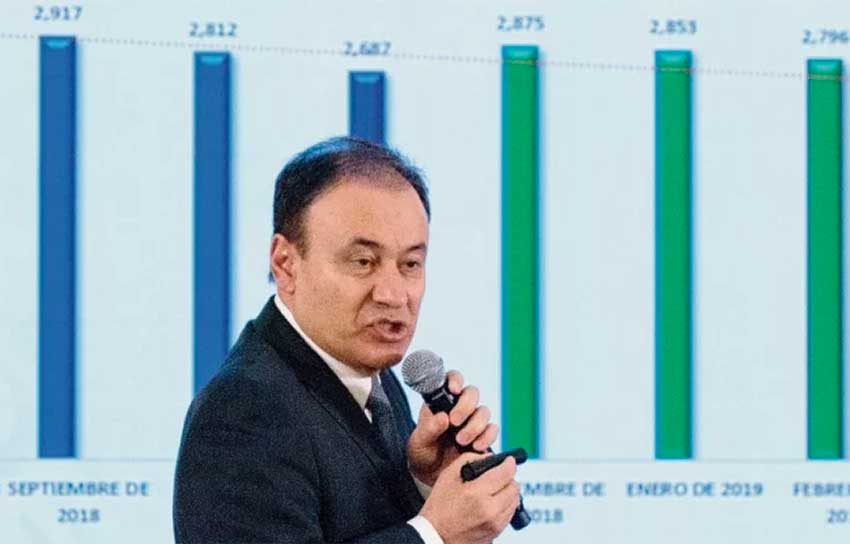
Durazo rejected statistics from the National Public Security System (SNSP) that show that the number of homicides has continued to rise since President López Obrador took office in December, presenting graphs that demonstrate that the government is beginning to control violence.
The security chief said the current administration inherited a country “in ruins” and like López Obrador, acknowledged that ending insecurity will not happen as quickly as they would like.
“This situation of insecurity wasn’t created from one day to the next and it would be irresponsible to expect to solve it from one day to the next,” Durazo said.
Source: El Universal (sp)