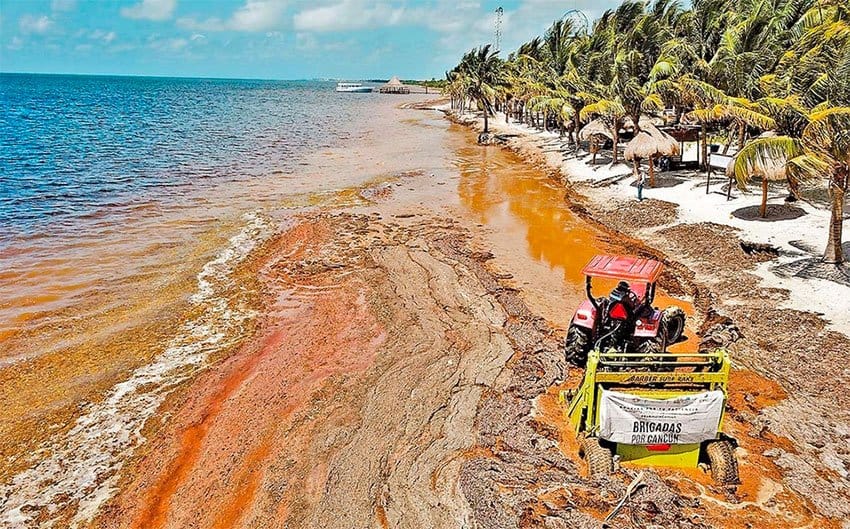
Better think twice before cooking up a pot of sargassum stew.
Scientists in Mexico and the United States have detected high levels of arsenic and heavy metals in sargassum that washed up on Quintana Roo beaches.
Rosa Elisa Rodríguez Martínez, a researcher at UNAM’s reef systems unit in Puerto Morelos, said the “serious levels” of arsenic and heavy metals such as cadmium represent a risk to both human and animal health.
She said that arsenic levels 60% higher than those permitted in human and animal food products were detected in the sargassum samples taken from beaches in Puerto Morelos and Playa del Carmen in the north of the state and Othón P. Blanco in the south.
Rodríguez said heavy metal levels as high as 120 parts per million were detected in some of the samples.
She explained that the scientists who carried out the tests sought the assistance of nutrition experts to determine whether the seaweed could still be used as fodder for livestock or compost.
Rodríguez added that more meticulous sargassum testing, including samples collected from beaches in other parts of the state, needs to be completed to establish just how toxic the seaweed is.

She recommended that anyone considering preparing meals with the macroalgae hold off until further test results are released.
The samples were analyzed at laboratories of the National Autonomous University (UNAM) and the Ecology Research Center in Miami, Florida.
Scientists have previously warned that sulfuric acid and arsenic from sargassum could seep into Quintana Roo’s freshwater sources and pose a risk to human health.
Massive quantities of sargassum have been predicted for Mexico’s Caribbean coastline this year, which could cause a significant decline in tourist numbers.
Most of the macroalgae collected from beaches is disposed of but entrepreneurs are increasingly using sargassum in a range of commercial products including food and beverages, paper, cosmetics, shoes and construction materials.
Source: Milenio (sp)