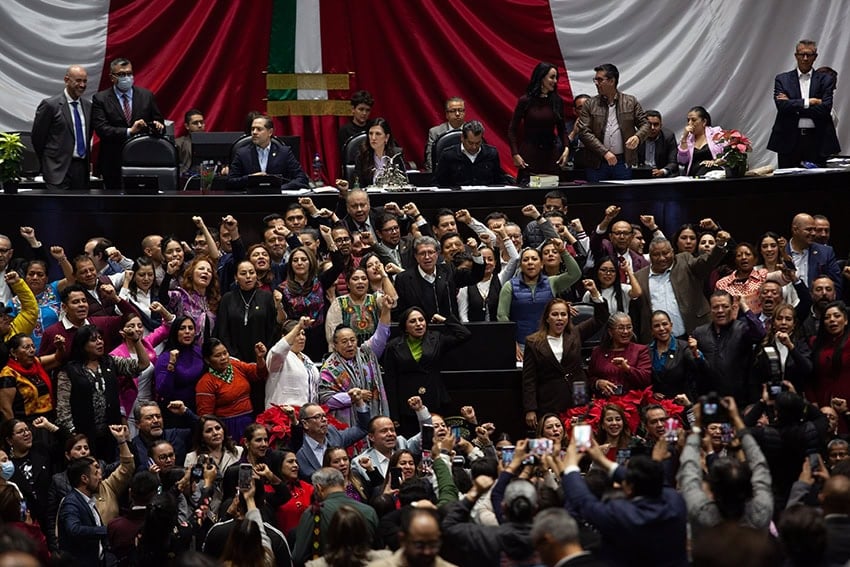
Mexico’s lower house of Congress has approved a bill aimed at issuing a new General Water Law and modifying the existing National Water Law, legislation that has led farmers to block highways and border crossings between Mexico and the United States.
The Chamber of Deputies approved the bill en lo general, or in a general sense, on Wednesday, ahead of considering individual articles and proposed modifications to those articles. After considering the modifications on Thursday, the Chamber of Deputies also approved the legislation en lo particular.
All told, 328 deputies voted in favor of the legislation on Wednesday, while 131 opposed it and there were five abstentions. The numbers were similar on Thursday. The ruling Morena party and its allies supported the bill, ensuring its approval in the lower house.
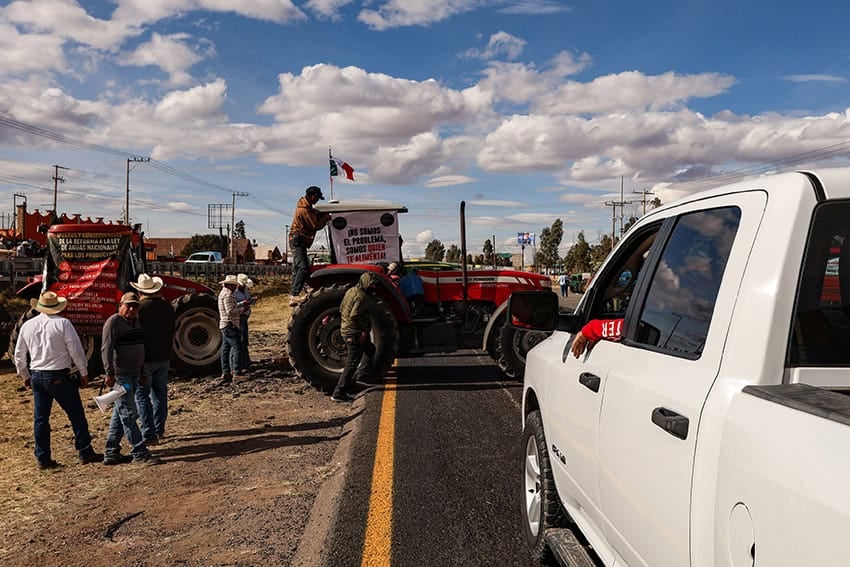
The vote on Wednesday took place after dozens of farmers arrived on tractors at the Chamber of Deputies in Mexico City to protest the water legislation. They blocked an entrance to the building as part of their protest against the bill, which seeks to impose tighter controls on the use of water.
As the water legislation was being debated in Mexico City, farmers also blocked highways in various parts of the country, including Zacatecas and Guanajuato, and stopped traffic headed toward international bridges between Ciudad Juárez, Chihuahua, and El Paso, Texas. The blockades on the northern border continued on Thursday.
The approval of the water legislation came after farmers and truckers blocked highways across Mexico last week to protest the water legislation as well as low purchase prices for crops and insecurity that plagues the national highway network.
What is the water legislation seeking to do?
Among the aims of the water legislation are to establish new rules to govern the use of water in productive processes, including in the agricultural sector; to create new regulations for the issuance of new water concessions, as well as for those that have already been issued; and to ensure that water is used sustainably and is available for all Mexicans.

The director of the National Water Commission (Conagua), Efraín Morales, said last week that “the main change” put forward by the federal government in its legislation is for water to cease being seen as a “good” and instead be recognized “as a human right” and a “strategic” resource “for the development of our country.”
He said that if the legislation is approved, the Mexican government will be the only entity authorized to issue water concessions.
Morales also said that the legislation will “strengthen procedures to combat water theft” and increase penalties for that crime. In addition, it will combat acaparamiento (water hoarding or stockpiling), establish regulations for rainwater harvesting and enable the creation of a national water reserve, the Conagua chief said.
If the legislation is approved by both houses of Congress, harsh penalties, including large fines and multi-year prison terms, could be imposed on anyone found guilty of improperly selling or transferring water concessions, or bribing officials to obtain concessions.
Farmers’ concerns
Farmers have asserted that the enactment of the water legislation will have a negative impact of their capacity to produce food both for domestic consumption and export. They claim that their access to water via their existing permits will be reduced and that there is ambiguity about whether they will be able to bequeath and inherit water concessions.
“If it affects the countryside, it affects the city,” read a banner on display at the protest outside the Chamber of Deputies on Wednesday.
Truckers end blockades after marathon negotiation results in an accord
“It’s a law that threatens production,” Jorge Robles, a farmer from Chihuahua, told reporters outside the lower house.
“The primary sector is the base of the economy … and in this country it appears they want to put an end to the economy,” he said.
Elena Burns, a former Conagua official and now a water activist, said that “the law says that if you don’t use water during two years, you lose the concession.”
“That is also a blow to the countryside,” she said, asserting that there is an “intention” to “take away water from the countryside to put it in reserves for discretional use.”
The newspaper El País reported that critics of the water legislation have described it as “the final nail in the coffin of the Mexican countryside.”
It also reported that the “the core of the conflict” between farmers and the government “lies in the fact that concessions for water use will no longer be able to be transferred between private parties, and must return to the state so that the National Water Commission can reassign them.”
“The justification for this prohibition is to eliminate the illegal market for concessions that has developed in the country. According to the farmers, this will make it impossible for them to bequeath or sell their land, since without the permit for water use, it has no value. This gives an advantage to large companies that will acquire their lands at laughable prices,” El País wrote.
The debate
President Claudia Sheinbaum and Morales have asserted that famers will indeed be able to inherit and pass on water concessions. However, if a farm is sold, the purchaser will not be able to use the applicable water permit if they intend to change the use of the land from agricultural to residential or industrial.
To address farmers’ concerns, some modifications to the water legislation have already been made, while others were proposed. Many of the proposed modifications were debated by deputies on Thursday.
A package of 18 modifications that Morena and its allies claimed would address farmers concerns were approved on Thursday via the en lo particular vote. However, opposition deputies asserted that none of the modifications “solve [the problems] they say they solve,” the El Universal newspaper reported.
It remains to be seen whether farmers will be happy with the modified bill, which will now be considered by the Senate. Adán Augusto López Hernández, the Morena party’s leader in the Senate, said Thursday that the bill was on a fast track to Senate approval and would be passed without changes.
Deputies who voted in favor of the water legislation, namely representatives of Morena, the Labor Party and the Green Party, denied claims that it will have a negative impact on farmers. For their part, opposition lawmakers asserted that Morena is seeking to control water, limit its use on agricultural land and use the resource for political purposes.
“You want to steal the water and we want producers in the countryside to have more rights. This reform is dangerous,” said National Action Party Deputy Paulo Gonzalo Martínez.
The Institutional Revolutionary Party’s leader in the Chamber of Deputies, Rubén Moreira, asserted that the legislation could be unconstitutional due to a failure to consult with the nation’s Indigenous peoples and communities on the issue of water before it was drawn up. In that context, he warned that legal challenges against the legislation could reach the Supreme Court.
With reports from El Economista, El País, La Jornada, AP and DW