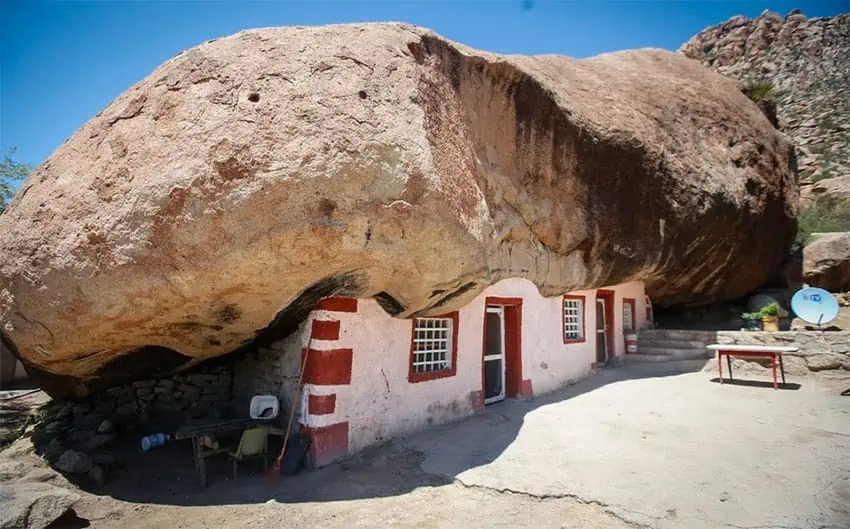
While Mexico as a whole may have suffered a blow to its tourist trade this year, an unusual tourist magnet still exists deep in the Coahuila desert, attracting intrepid visitors from far and wide: a home built directly into a 15-meter-high, 850-tonne boulder that hangs over it.
San José de las Piedras already attracts some tourists due to prehistoric cave paintings and hiking trails in the area. Gold prospectors and archaeology and paleontology enthusiasts also visit. And so despite tourism being down all over Mexico, the community is still attracting visitors, many of whom make a stop at the one-of-a-kind home built by Benito Hernández.
Visitors come from both inside and outside Mexico and Hernández, 70, welcomes them all with open arms, saying he enjoys the fact that his home has become a tourist site. He believes part of the attraction right now is that the desert area is so remote and therefore safer than the bigger cities from which many of his visitors arrive.
“Here we don’t have any [coronavirus] and I believe that people who are afraid of it come here for the desert … Here there’s no disease, there’s nothing.”
Hernández, whom his neighbors have dubbed “The Man of the Caves,” started building the rustic home decades ago in San Miguel, a remote environmentally protected area 400 kilometers from Piedras Negras and about 800 kilometers from Texas. But he has been captivated by the site nearly all his life. He first saw the rock formation about 60 years ago as an 8-year-old and never forgot it.
“I thought, ‘One day, when I’m grown, I’ll marry and have kids and come back here.’”
Twenty years later, he managed to buy the site and he and his wife began to convert the spot into a home, doing extensive and exhausting excavation work to make a house fit.

“I suffered everything: cold days, sunny days, hunger,” he says. “I got fed up at times, but I worked on it for my wife and seven children. My oldest, who is 43, grew up here.”
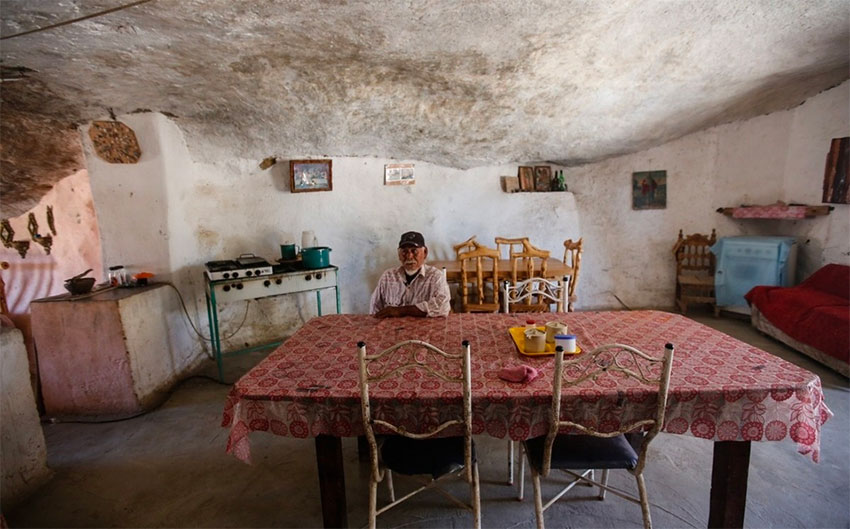
The result is like something out of a fairy tale or a fantasy novel: the large rock formation serves literally as the home’s roof and is visible from the inside. It is the home’s main architectural feature, having been built around the boulder’s shape. His bed, for example, only has a few feet of clearance beneath the ceiling. The house has a wood stove for heat and uses gas lanterns for lighting.
But the rock roof offers protection against weather extremes. Hernández says the outside temperature can drop to -7 C or climb to a stifling 47 but inside the three-room house remains comfortable.
Despite its unique qualities, the home has not only attracted tourists but also interested buyers. Hernández claims he’s been offered as much as 2 million pesos for the property. But he’s not interested in selling at any price what he considers his life’s work as well as a family homestead.
“I have seven children, and those seven children are up to their ears in grandchildren,” he says. “I’m living here until God says otherwise. I’m not leaving.”
Source: Milenio (sp)