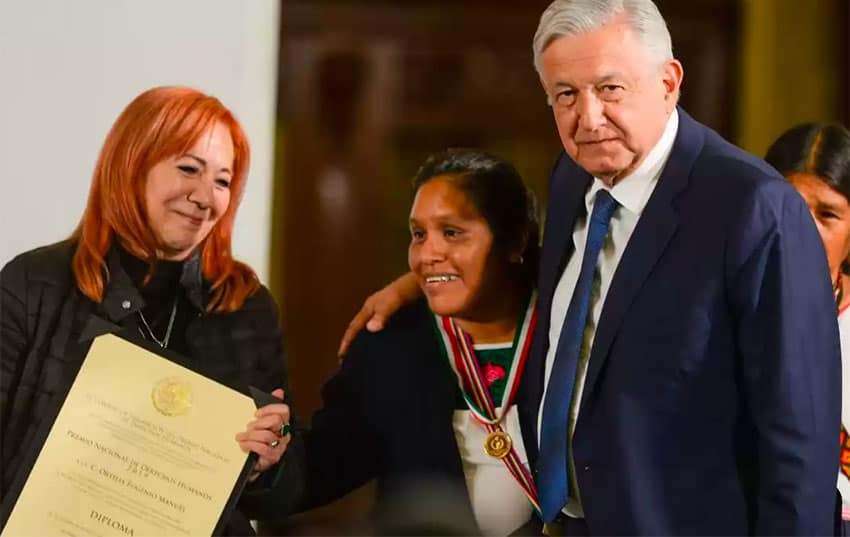
An indigenous activist who documented and denounced abuse committed by the military in Guerrero is this year’s winner of the National Human Rights Prize.
Obtilia Eugenio Manuel was awarded the prize at Tuesday’s presidential press conference by National Human Rights Commission (CNDH) president Rosario Piedra Ibarra.
“. . . Eugenio Manuel, member of the Mep’haa Indigenous People’s Organization, has distinguished herself by denouncing abuses committed by army personnel against indigenous people, particularly women,” Piedra said.
The human rights chief said that among the military abuses that have been documented by Eugenio are the forced sterilization, sexual assault and sexual torture of indigenous women. Piedra also said the activist has received numerous threats and noted that she was abducted for four days earlier this year.
Eugenio, a Mixteca woman from the municipality of Ayutla, said her father encouraged her to study and learn Spanish in order to be able to defend the rights of indigenous people.
She recalled that after the Zapatista Army of National Liberation uprising in Chiapas in 1994, soldiers arrived in her community and accused residents of being Zapatistas.
“They raped women; there was never justice but we started to organize ourselves. [But] soldiers raped two women from the organization again. From that time, we’ve been harassed and threatened by army people who are complicit with people from organized crime,” Eugenio said.

“We don’t want one more rapist in our way,” Eugenio said, making a reference to the Chilean feminist anthem that has been performed around the world in recent weeks.
Also at Tuesday’s press conference, Piedra recognized the human rights work of Margarito Díaz González and presented an award to his widow, Modesta Chávez de la Rosa.
A former member of the Wirikuta security council and an advocate for environmental and indigenous rights, Díaz was murdered in Nayarit last year.
Piedra recalled that the activist opposed the construction of a dam and other projects in San Luis Potosí and the development of Canadian-owned mines on sacred sites of the Huichol people.
Source: El Financiero (sp)