Heavy rains began to fall in the pre-dawn hours of Wednesday as Hurricane Genevieve closed in on Baja California Sur.
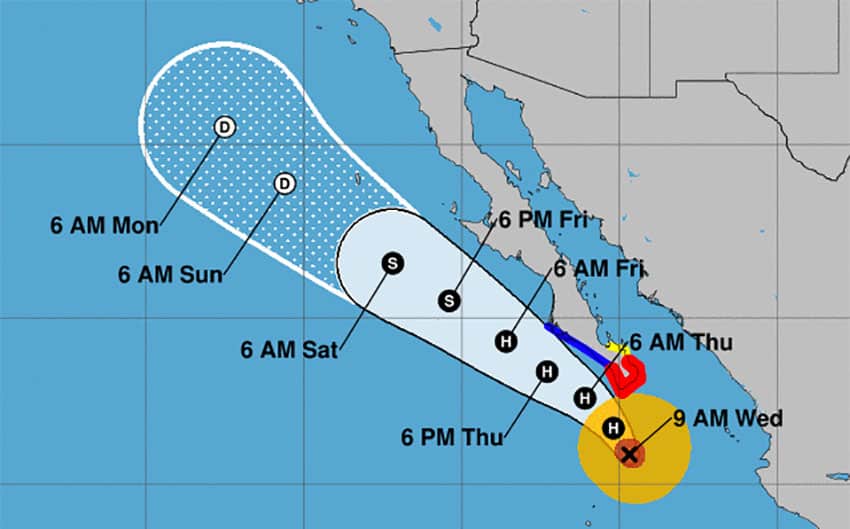
According to the U.S. National Hurricane Center on Wednesday morning, Genevieve was a Category 3 hurricane located 225 kilometers south of the tip of the Baja peninsula with sustained winds of 185 kilometers per hour. The cyclone was moving north northwest at 15 kilometers per hour.
The Mexican government has issued a hurricane warning from Los Barriles to Todos Santos, indicating that hurricane conditions are expected within the next 24 hours.
A tropical storm warning is in effect from Todos Santos to Cabo San Lazaro, and a tropical storm watch has been issued from Los Barriles to La Paz.
The eye of the hurricane is projected to skirt the peninsula later tonight and Thursday. Hurricane-force winds extend outward up to 55 kilometers from the center, and tropical-storm-force winds extend outward up to 220 kilometers.
Genevieve is expected to produce rainfall of 76 to 152 millimeters with isolated totals of 254 millimeters, which may cause flash floods and mudslides in southern Baja.
Genevieve formed Sunday night as a tropical storm and rapidly accelerated to become a Category 4 hurricane before weakening slightly. Although initially expected to pass well west of the Baja peninsula, Genevieve took an unexpected turn north, bringing it closer to land than was first projected.

This track is similar to Hurricane Odile, which made landfall on September 14, 2014, near Cabo San Lucas with 205 kilometer-per-hour winds and dropped up to 220 millimeters of rain. The cyclone caused widespread damage to the resort destination.
With Odile as a not-so-distant memory, supermarkets in Los Cabos were mobbed Tuesday as panicked residents stocked up on supplies.
Beaches and ports were closed during the afternoon due to the storm surge. Tragically, a 15-year-old tourist was swept out to sea Tuesday in the normally calm waters of Cabo San Lucas bay. Both she and the lifeguard who attempted to rescue her drowned.
Residents in shanty-towns built in low-lying areas were being evacuated to 12 shelters in the area earlier Wednesday morning. Masks and antibacterial gel are being made available, and special areas for coronavirus patients have been designated.
Civil Protection officials in Los Cabos are asking citizens to remain in their homes. Alaska and Southwest airlines have canceled flights to and from Los Cabos. The Los Cabos Hotel Association reports that 8,500 tourists are currently in Los Cabos.
Source: Cabo Mil Noticias (sp), BCS Noticias (sp), Excélsior (sp)
CORRECTION: Flights to and from Los Cabos have been canceled by Alaska and Southwest — not Northwest — airlines. Information provided by authorities for the earlier version of this story was incorrect.