If you have a computer, credit card and your own home you’re middle class

The middle class has become the target of sweeping examinations in the political sphere since the June 6 elections, in which wealthier parts of Mexico City voted for the opposition.

But who exactly belongs to the social group?

The National Statistics Institute (Inegi) has conducted a study to define the middle class, despite the notorious difficulty of categorizing populations into class brackets.

Quantifying the middle class in Mexico: an exploratory exercise highlights that 42.2% of households can be categorized as middle class, which house 39.2% of the population.

In urban areas, the middle class resides in a majority of households, at 50.1%, which covers 47% of the population. In contrast, only 28.1% of households and 26% of the population in rural areas belong to the sector.

The upper class is a minute portion of society, counting for only 1.7% population nationally, and 2.5% of households.

Some characteristics were found by Inegi to be indicative of a middle class family. According to the study, a middle class household is likely to have a computer, and a married couple in a four-person family.

The head of the household is likely to have a high school education, be a property owner or mortgage payer, and work in the private sector.

In terms of spending, a middle class credit card is used for expenses of 1,660 pesos (around US $84) per month, and food and drink bought outside the home is likely to cost the household about 4,380 pesos per quarter.

Another study by the Organization for Economic Cooperation and Development (OECD) suggested that the middle class is becoming an increasingly exclusive social bracket. Under pressure: the reduction of the middle class published in 2019 showed that young people are ever less likely to join it.

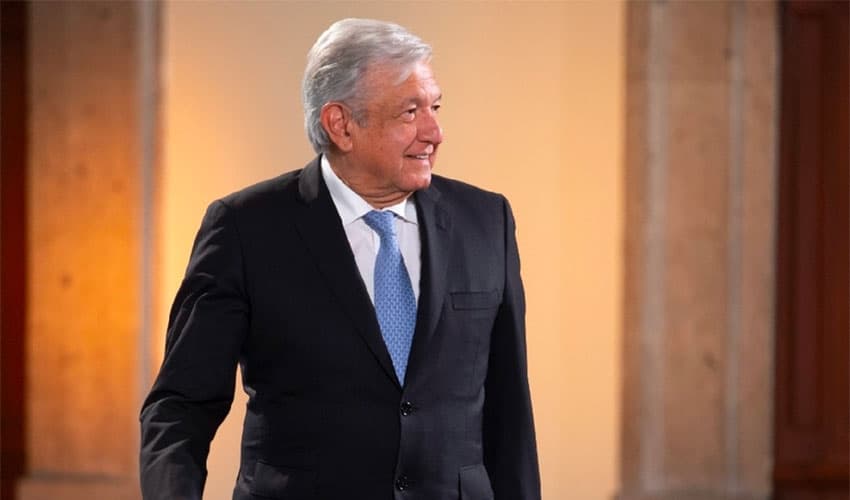
After the June 6 elections the socioeconomic segment became a target for criticism by President López Obrador, who branded it “aspirational and selfish” and prepared “to succeed at all costs.” He also said a manipulated middle class was what allowed Adolf Hitler’s fascism to grow in Germany, and supported the dictatorship of Augusto Pinochet in Chile.

With reports from Milenio

Have something to say? Paid Subscribers get all access to make & read comments.
Manzanillo, Colima, México, 13 de marzo de 2026. La doctora Claudia Sheinbaum Pardo, presidenta Constitucional de los Estados Unidos Mexicanos en conferencia de prensa matutina, “Conferencia del Pueblo” desde Colima. La acompañan Indira Vizcaíno Silva, gobernadora Constitucional del Estado de Colima; Omar García Harfuch, secretario de Seguridad y Protección Ciudadana (SSPC); Raymundo Pedro Morales Ángeles, secretario de Marina (Semar); Bulmaro Juárez Pérez, divulgador de lenguas originarias, presentador de la sección “Suave Patria”; Ricardo Trevilla Trejo, secretario de la Defensa Nacional (Sedena); Jesús Antonio Esteva Medina, secretario de Infraestructura, Comunicaciones y Transportes; Bryant Alejandro García Ramírez, fiscal general del Estado de Colima; Fabián Ricardo Gómez Calcáneo; Rocío Bárcena Molina, subsecretaria de Desarrollo Democrático, Participación Social y Asuntos Religiosos de la Secretaría de Gobernación; Efraín Morales López, director general de la Comisión Nacional del Agua (Conagua); Marcela Figueroa Franco, secretaria ejecutiva del Sistema Nacional de Seguridad Pública (SESNSP) y Guillermo Briseño Lobera, comandante de la Guardia Nacional (GN). Foto: Saúl López / Presidencia

Mexico’s week in review: Congress deals Sheinbaum her first legislative defeat

1
The week of March 9 in Mexico was marked by standoffs between allies in Congress and adversaries at the airport. Here's what you missed.
A soldier displays seized handguns

The US and Mexico, growing together and growing apart: A perspective from our CEO

1
From a historic drop in homicides to opposite bets on electric vehicles, Mexico News Daily's CEO breaks down where the U.S. and Mexico are converging — and where they're not.
Veracruz Gov.

Veracruz governor blames private vessel for 200-kilometer Gulf Coast oil spill

1
The spill, which has spread to over 200 kilometers of Mexico's Gulf Coast beaches, has been traced to a private oil tanker off the coast of Tabasco.
BETA Version - Powered by Perplexity