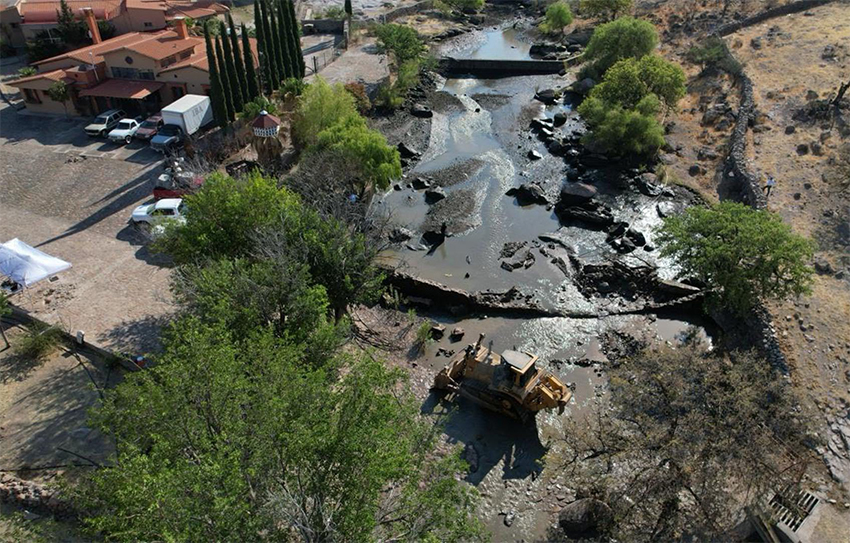
Mexico’s National Water Commission on Thursday began demolishing an illegal dam on a ranch owned by a former Chihuahua governor, releasing water that could be used to help repay the country’s water debt to the U.S.
The process to dismantle the unauthorized infrastructure began on Tuesday when the water commission (Conagua) filed a complaint with the Federal Attorney General’s Office over the illegal use of at least 700,000 cubic meters of water.
President Claudia Sheinbaum defended the lawsuit, saying water is a national resource and cannot be privately appropriated without government-issued concessions.
Conagua’s operation was briefly interrupted when the ex-governor, César Duarte, obtained an injunction against the demolition of the dam.
After quickly overturning the court order on appeal, Conagua bulldozed the dam before moving to demolish reservoirs on the El Saucito ranch that held as much as 3 million cubic meters of water, according to reports.
The release and recovery of this water is linked to Chihuahua’s Río Conchos basin which is included in the 1994 water-sharing agreement with the United States.
Sheinbaum said the government’s actions in El Saucito are part of a broader effort to regulate water concessions and ensure equitable access to water as a human right — especially in regions facing scarcity.

The president said her administration will continue to review all concessions to ensure proper use and registration, and will sanction any instances of unauthorized use.
The El Saucito ranch
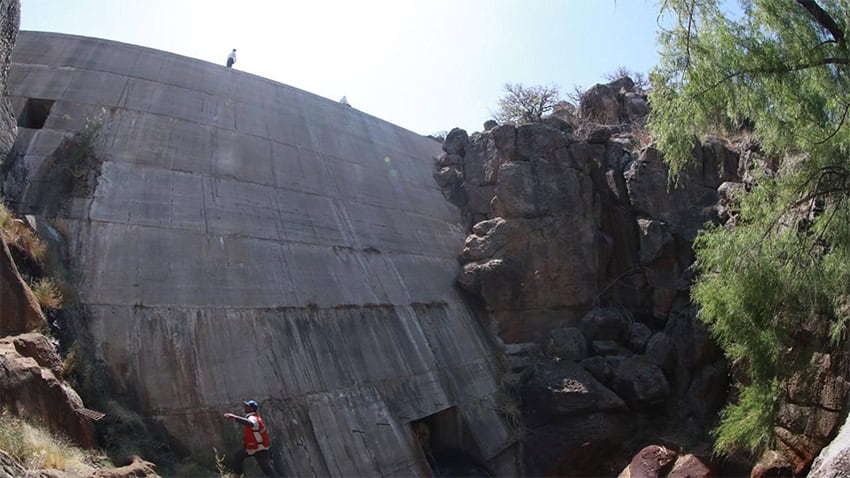
While governor, Duarte — who served two years in prison for allegedly embezzling 96 million pesos (US $4.9 million) in government funds — built a dam, four reservoirs and a well at El Saucito without the proper permits.
Located in a remote, desert area of central Chihuahua, El Saucito was designed as a cattle ranch and walnut farm.
Duarte built the dam to redirect water from an arroyo (seasonal stream) that descends from the Sierra Madre Occidental. According to local Conagua representative Román Alcántar, the infrastructure prevented the water from draining into the Río de las Agujas, a tributary of the Río Conchos to the east of the ranch.
The Río Conchos is the main river in the state of Chihuahua and is one of only four permanent, year-round rivers in the state. It is a primary tributary of the Río Bravo, or Rio Grande, and features several dams, a few of which are used to share water with the U.S. under the 1944 U.S.-Mexico Water Treaty.
El Saucito is one of eight Duarte ranches that were confiscated by the government during criminal proceedings. The former governor, who was in office from 2010-2016, allegedly used public funds to finance improvements on these properties. El Saucito was reportedly the crown jewel.
Duarte was extradited to Mexico from the United States on June 2, 2022, almost two years after he was arrested in Florida on corruption charges. He was released from prison in July 2024, but still has 18 charges pending against him.
With reports from N+, Milenio, La Jornada, OEM and El País