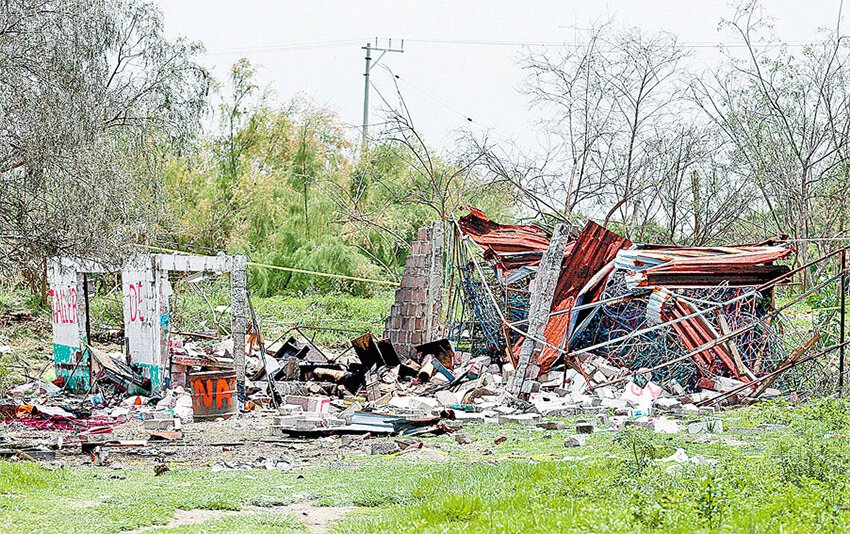
In Mexico’s self-declared fireworks capital, illegal manufacturers and vendors of the explosives dominate the local industry, increasing the risk of tragic accidents, according to a municipal government official.
Juventino Luna, director of artisanal development and pyrotechnics in Tultepec, México state, told the newspaper Milenio that local authorities know of around 700 fireworks-related businesses that are operating unlawfully in the municipality.
In contrast, those with official permission to make and distribute the explosives — which is granted by the federal Secretariat of Defense (Sedena) — number just 585.
Since an explosion in Tultepec’s San Pablito market in December 2016 that left 42 people dead, Luna said that there have been a further nine fireworks accidents, mainly at workshops without Sedena authorization.
For that reason, the municipality is lobbying higher authorities for the power to regulate the industry at a local level.
Luna said right now all the municipality can do is “raise awareness” about the dangers of making fireworks and “carry out campaigns” aimed at dissuading people from making and storing the explosives at their homes or transporting them without the relevant licenses.
The dangers of fireworks were again brought into sharp focus when more than 500 people were injured during Tultepec’s annual fireworks fair in March while an explosion at a fireworks workshop in the city earlier this month killed seven.

On Monday of this week, another workshop blast left one person dead and a further eight with injuries.
Although that workshop had permission from Sedena to operate, Luna said the incident shows that “human error” can still lead to accidents, although he added that “the risk is less.”
The official pointed out that the manufacture and distribution of fireworks is the most important economic activity in the municipality and estimated that 30% of local families depend on it for their livelihood, further underscoring the need for regulations at a local level.
Meanwhile, the leader of a fireworks merchants’ union at the San Pablito market said that a new market will open in August, one that was specifically designed to prevent a another disaster similar to the 2016 tragedy.
Germán Galicia said that shops within the new market are made out of reinforced concrete while it also has built-in security features such as firewalls and lightning rods.
“The stores are a little bit smaller to avoid excess storage [of fireworks and] between every establishment there are air pockets measuring 60 centimeters so that in the case of a fire it doesn’t spread from store to store,” he added.
The state government contributed 35 million pesos (US $1.7 million) for the construction of 150 stores within the market while the Tultepec municipal government chipped in seven million pesos (US $346,000) towards building its 150 other stores.
Source: Milenio (sp)