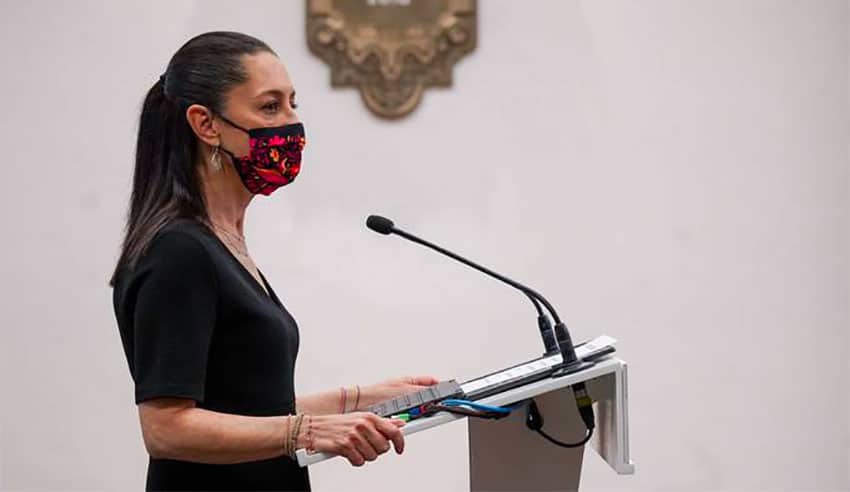
Mexico City Mayor Claudia Sheinbaum has a higher approval rating than the country’s president, according to a recent survey by El Financiero and Bloomberg.
Of the 600 Mexico City residents surveyed on April 9 and 10, 71% said they approve of Sheinbaum’s performance in office, while only 55% responded in kind when asked about President López Obrador.
The disapproval ratings were also favorable to Mayor Sheinbaum: 43% of those surveyed rated the president’s performance negatively, while only 26% gave the mayor a bad review.
There was also some good news for Morena, the political party of both leaders. Voting intentions for the June 6 legislative elections gave the party a strong hand in Mexico City, according to the survey.
Forty-four percent of decided voters said they favor Morena. Only half as many said they would vote for the right-wing National Action Party (PAN) while 11% would support the Institutional Revolutionary Party (PRI) and 6% the Democratic Revolution Party (PRD). Fully 25% of those polled were undecided.
In 2014 Sheinbaum broke from the traditional left-wing PRD to join López Obrador’s splinter movement, forerunner to the Morena party. Both were elected in the Morena sweep of the polls in 2018, when Sheinbaum became Mexico City’s first female mayor.
She is widely seen as a frontrunner — along with Foreign Affairs Minister Marcelo Ebrard — to succeed López Obrador as the Morena candidate in 2024.

Source: El Financiero (sp)