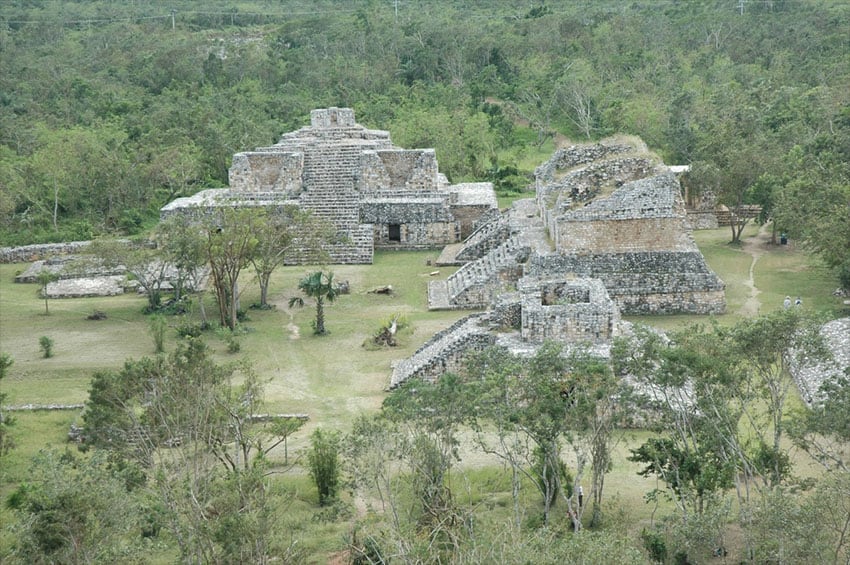
The federal government has announced the discovery of an “impressive” archaeological site along the route of the Maya Train railroad in Quintana Roo.
Diego Prieto, director of the National Institute of Anthropology and History (INAH), said that the site has more than 300 buildings, some of which are over 8 meters high.
“Engineering adjustments are being made to the southern part of section 5 [of the railroad] in order to protect an impressive archaeological site that we’ve recognized as Paamul II,” he told President López Obrador’s regular news conference on Thursday morning.
“This site … will be protected as [part of] an … ecological and archaeological corridor,” Prieto said.

The southern part of section 5 of the railroad (Tramo 5 Sur) will link Solidaridad, the municipality where Playa del Carmen is located, to Tulum.
The government decided to move the route inland earlier this year after the Playa del Carmen business community complained about the construction of the railroad through that city. Environmentalists have protested the modified route as its construction requires the clearing of significant sections of virgin forest.
Prieto said that INAH’s archeological review of the land along Tramo 5 Sur is only 11% complete. Divers are also working to “recover very valuable material” and “assist the safety of the work in this section” where there are subterranean rivers and cenotes (natural sinkholes), he said.

“[The divers] are working in caverns, in flooded caves, in cenotes and they’re providing very valuable information … that speaks of very ancient times. There is Pleistocene [ice age] fauna in these caverns,” Prieto said.
The INAH chief also said that more than 25,000 “immovable assets” have been found along the different sections of the Maya Train railroad, which will run through Tabasco, Campeche, Yucatán, Quintana Roo and Yucatán and is slated to begin operations in 2023.
Among them are pre-Hispanic structures and “ancient roads,” he said, explaining that the discoveries are evidence of Mayan settlements “throughout this region of our country.”
Among the other significant discoveries made by INAH personnel are 431 complete ceramic pots and 423 bones “corresponding to [pre-Hispanic] human burials.”
Prieto said that the valuable relics will be displayed in museums, including a new one that will be established in the historic center of Mérida, Yucatán, especially for “Maya Train discoveries.”
Mexico News Daily