Indigenous activists used axes, sledgehammers and rope Monday to topple statues in Morelia, Michoacán, that were part of a depiction of their ancestors being exploited by Spaniards during colonial times.
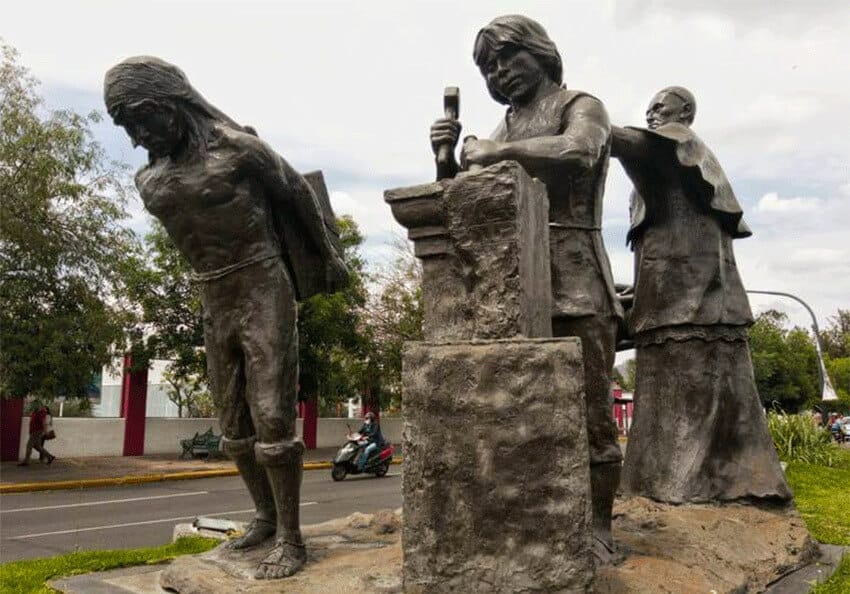
Purépecha members of the Supreme Indigenous Council of Michoacán brought down statues of Fray Antonio de San Miguel, a former bishop of Michoacán, and a Spanish town planner known as Alarife.
The group of four statues – called “The Builders” – showed two Purépecha men being forced to work. Fray Antonio, who supervised construction of an aqueduct in Morelia in the 1780s, was depicted ordering one near-naked man to cut stone while the other indigenous man carried a heavy stone on his back.
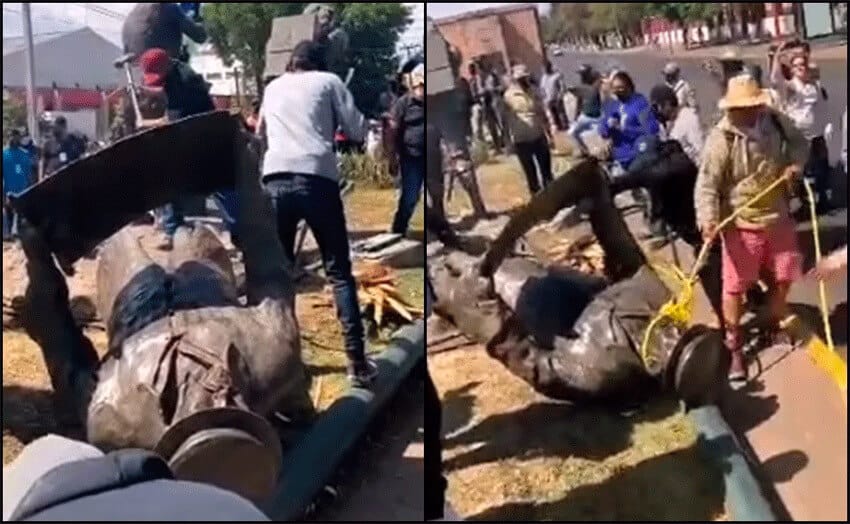
Videos posted to social media showed a large group of people pulling a rope placed around the neck of the statue of the priest. They succeeded in toppling the likeness of the 18th century bishop after various attempts, the newspaper El Universal reported.
The head was subsequently removed and taken away, while the body was abandoned at the site where it previously stood on Avenida Acueducto, a major thoroughfare in the Michoacán capital.
At least 24 people who contributed to the toppling of the statues were arrested and will presumably face vandalism charges.
The Purépecha people have been opposed to the statues since they were erected in 1995, and the Supreme Indigenous Council had been asking local authorities to remove “The Builders” for months, arguing that the monument promoted racism and discrimination.

The council noted in a statement that “2022 marks 500 years since the conquest and invasion of Michoacán” by the Spanish.
“During the invasion of what is today Michoacán, the Spanish enslaved thousands of indigenous people. Five hundred years after the invasion of Michoacán, the indigenous people continue to resist and fight as our grandfathers did,” it said.
Morelia’s cultural heritage authority defended the monument in a statement issued in 2020.
“You just have to read the simple and clear plaque on the monument to feel pride in our city, the birthplace of great thinkers,” the statement said. The authority denied that Morelia was built with slave labor.
Ramón Sánchez Reyna, a historian and professor at the Michoacán University of Saint Nicholas of Hidalgo, opined that the destruction of “The Builders” – the work of sculptor José Luis Padilla Retana – amounts to a loss of tangible heritage in Morelia.
He told the news website Contramuro that social memory is not erased with such actions, and asserted that the activists should seek alternative ways to build support for their cause.
“… As a sculptural piece it has value. I respect and recognize the work of … Padilla Retana,” Sánchez said.
He noted that a statue of Antonio de Mendoza, the first viceroy of New Spain, was previously knocked down in Morelia, but it was recast and reinstalled.
The historian acknowledged that the toppling of statues of historical figures in Morelia is part of a trend that has been seen in Europe and the United States.
In Mexico City, a statue of Christopher Columbus was removed in late 2020 – ostensibly for restoration – after protesters threatened to knock it down on Día de la Raza (Day of the Race).
Mexico City authorities subsequently announced that the statue would be relocated and a replica of a pre-Hispanic sculpture of an unknown indigenous woman would be installed on Reforma Avenue.
The director of the National Institute of Anthropology and History said last October that the relocation of the Columbus effigy was an attempt to protect it.
“This was based, not on any ideological judgement of the character [of Columbus]. … If it had been left in place, it would have been the target of threats and protests,” Diego Prieto said.
With reports from El Universal, AP and Contramuro