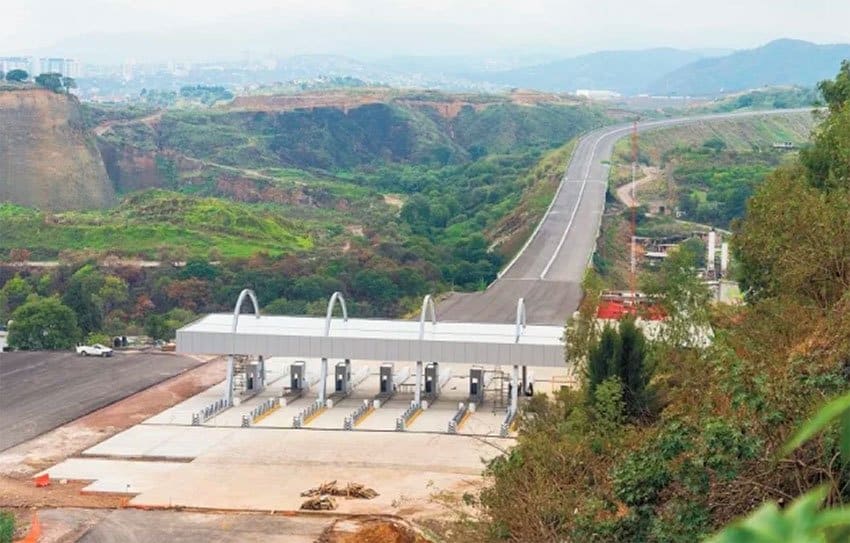
Residents of two indigenous communities in México state obtained an injunction last December that halted construction of the Toluca-Naucalpan highway, an 8-billion-peso (US $418-million) project that encroached on their land.
But despite the legal victory, work has continued on the road, leading residents of Huitzizilapan, one of the two Otomí communities that filed last year’s injunction request, to take a different approach to stop the project: they’re asking for the return of their land.
Although the highway is almost 80% complete, one key factor is on their side: a decree issued by former president Enrique Peña Nieto in 2014 that expropriated their forest land for the project expired on May 29.
In that context, communal landowners, local authorities and other community groups from Huitzizilapan on June 17 filed an unprecedented legal document with Fifonafe, an agency of the Secretariat of Agrarian Development and Urban Planning that deals with communal land matters.
The document entitled “request for the return of territory” states that there is currently no procedure within Mexico’s legal framework that allows the recovery of indigenous land after an expropriation decree has expired.
It is being argued that a new, unique process must be created in order to return the land to its owners, most of whom say they were not consulted before the expropriation occurred.
The contract to build the Toluca-Naucalpan highway was awarded by the México state government to Grupo Higa in 2007, the second full year of Peña Nieto’s six-year term as governor.

The company was a favored contractor of Peña Nieto, winning lucrative contracts from both his México state and federal governments.
According to Abundio Rivera, a representative for the Otomí community, México state authorities approved the highway project despite only a small minority of landowners granting their consent.
That consent, he argued, was obtained at meetings that didn’t comply with legal requirements and at which landowners were only informed about the supposed benefits of the project and not the drawbacks.
“It was an imposition with rigged meetings. They did it by dividing us, saying that it was going to bring progress and development,” Rivera said.
Hugo Hernández, a lawyer for the disgruntled Huitzizilapan residents, said his clients’ rights, both as landowners and indigenous people, have been violated.
Peña Nieto’s state and federal governments didn’t consult with the affected population in good faith or in a culturally sensitive way as stipulated in international agreements that Mexico has signed, he said.
The lawyer added that the demand goes beyond the return of the land, explaining that they also want compensation for the violation of their rights as well as for the negative impacts that the project has had on their physical, psychological and emotional health and well-being over the past 12 years.
To garner support for their cause, Hernández said the community of Huitzizilapan has launched an online campaign using the hashtag #ElBosquedeVuelta (The Forest Returned).
Asked about the claim for the return of land at his daily press conference this morning, President López Obrador responded, “we’re going to review the case . . . in order to know the legal situation . . .”
Source: El Universal (sp)