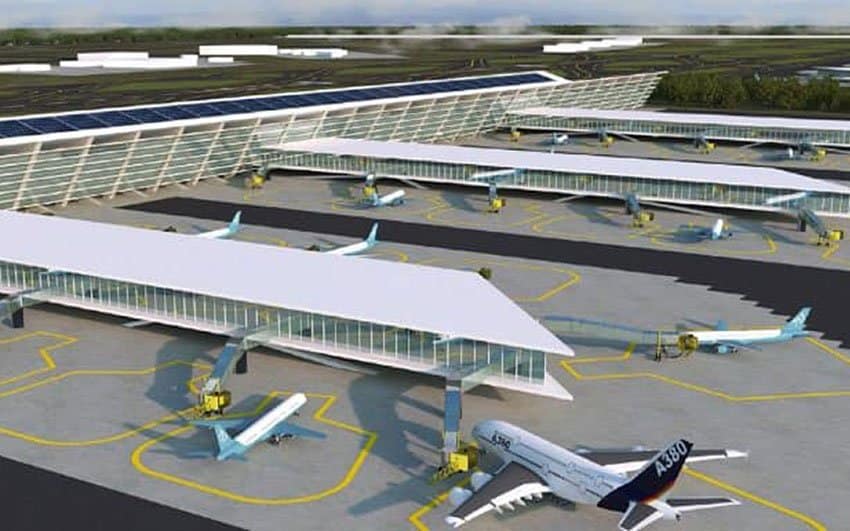
The federal agency responsible for transparency and freedom of information has ordered National Defense (Sedena) to release viability studies for the airport to be built at the Santa Lucía Air Force Base in México state.
National Transparency Institute (Inai) commissioners unanimously approved a request from a private citizen that asked them to direct Sedena to provide information about the airport project, including topographical and environmental studies and those related to the use of runways and airspace.
When asked directly by the citizen for the information, Sedena said it didn’t have the studies even though it has been given responsibility for building the airport.
Inai ordered the department to carry out an exhaustive search for the documents.
Commissioner Blanca Lilia Ibarra said it was essential for society to be informed about the construction of the Santa Lucía airport, which the federal government is pursuing after canceling the partially-built Mexico City airport.
Ibarra described the project as “urgent” considering the “saturation” of the current airport.
She cited data from the Secretariat of Communications and Transportation (SCT) showing that by 2021 airports in central Mexico will be required to meet the demand of 50 million passengers annually and 540 billion tonnes of cargo.

“That’s why we need a quality [airport] project that satisfies the transport needs of the center of the country,” Ibarra said.
The government also plans to upgrade the existing airport in Mexico City and the Toluca International Airport.
Alexandre de Juniac, general director of the International Air Transport Association (IATA), said in February that operating three airports within close proximity to each other in Mexico City and México state will be “complex” and “challenging.”
Some aviation experts contend that the Santa Lucía site and the existing Mexico City airport are too close together to operate simultaneously because aircraft would be dangerously close to each other in the same limited airspace as they descend to land.
Environmentalists have warned that the Santa Lucía airport could threaten water supply in the northern area of México state and Mexico City.
Despite concerns, the federal government remains committed to the project.
When he was sworn in on December 1, President López Obrador pledged that the 70-billion-peso (US $3.7-billion) Santa Lucía Air Force Base will be operating as Mexico City’s new airport in three years.
The president contends that canceling the airport initiated by his predecessor’s administration and pursuing the Santa Lucía project instead will save the government more than 100 billion pesos and solve the saturation problem at the current airport more quickly.
Source: Milenio (sp)