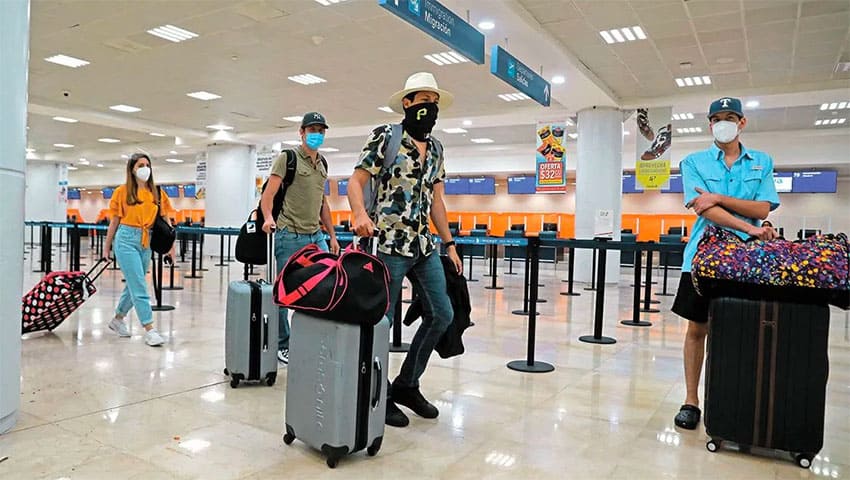
Mexico’s immigration department is assuring the public that visitors can enter the country through Cancún’s international airport in two minutes or less.
“The INM is working to maintain and offer rapid service, with quality and warmth,” the National Immigration Institute said Wednesday.
At its busiest hours on Tuesday, airport checkpoints processed nearly 9,000 visitors arriving on dozens of flights, the INM said.
The improved service follows a meeting between the INM and various government departments in response to concerns about long lineups. The institute agreed to provide 100 agents to process arrivals, up from just 13 before.
Mexico can be attractive for international visitors: a favorable exchange rate and few limits on travelers, who do not need to provide evidence of negative Covid-19 tests or commit to any isolation period upon arrival. Over the last Thanksgiving holiday, the number of Mexican destinations booked by Americans were higher than those booked in Europe, according to the insurance company Allianz.
Passengers heading to Mexico need only complete a form about their risk factors for Covid-19 and provide their contact details, but since Mexico has little ability to do contact tracing, the procedure is little more than an empty formality.
Passengers could also be screened for Covid-19 symptoms upon arrival in Mexico, but with a promised two-minute maximum transit time through immigration, even that seems unlikely.

March could provide Cancún and other Quintana Roo vacation destinations such as Tulum, Cozumel and Playa del Carmen with a badly needed infusion of cash with Holy Week falling between March 28 and April 3. Spring break travelers may be another factor but their numbers are not expected to be anywhere near as high as in previous years.
All of Quintana Roo’s major beach destinations are listed at medium-risk yellow on the coronavirus stoplight risk map, allowing hotels to book at 60% occupancy and some restrictions to be eased. And for the moment, beaches in Quintana Roo are open with a 60% capacity limit as well, although bars and clubs statewide are not open.
A boost in visitor numbers would be welcome: January arrivals at Cancún’s airport — one of Mexico’s busiest — were only 1.3 million in January, 54.7% lower than the same month in 2020, when about 2.3 million passengers arrived there. On the other hand, domestic tourism did considerably better, with domestic flights to the Cancún airport only down about 18%.
Still, the state has a long way to go to recover the level of tourism it had before the pandemic: tourism ministry figures show that Cancún and Puerto Morelos combined saw an average hotel occupancy of only 35.6% in January this year, compared to 80.8% last year. That represents a 45% decrease.
In the same period, other Quintana Roo destinations saw sharp decreases as well: Cozumel saw a 44% decrease while Isla Mujeres saw a decrease of 30%.
Source: Associated Press (en), El Economista (sp)