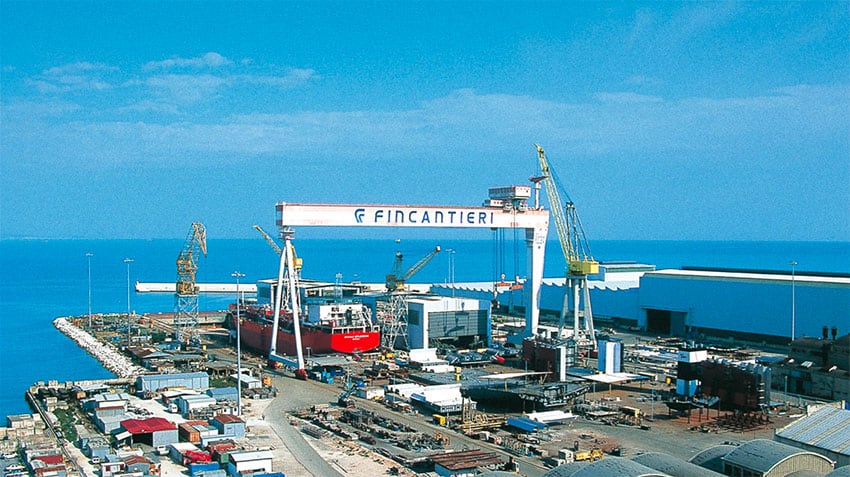
Latin America’s biggest shipyard will be built in Progreso, Yucatán, the Italian shipbuilder Fincantieri announced.
The company said it signed a letter of intent on Tuesday with the Yucatán Ministry of Economic Development and Labor to participate in designing and building a new ship repair, conversions and maintenance yard in the port city located on the Gulf of Mexico about 40 kilometers north of the state capital Mérida.
“Fincantieri will be granted a 40-year concession for the exclusive management of the new yard,” the company said in a statement.
Construction of the shipyard, which will include two dry docks on a 40-hectare site, is expected to cost between US $300 million and $500 million.
Fincantieri said the shipyard will be able to handle ships up to 400 meters in length, “particularly cruise ships, large cargo and oil and gas vessels, which need complex operations.”
It also said the yard will have “a lifting platform for units up to 150 meters in length” as well as “cranes, workshops, special equipment, offices, and warehouses.”
The yard is slated to start operations in 2024 but the project is not expected to be finished entirely until 2027.

“Initially, the creation of the yard will be carried out by the government of the state of Yucatán,” Fincantieri said, adding that the project will start in the first half of 2021.
“Indeed, the government will directly manage initial works through a special purpose company that will handle the dredging and the construction of infrastructure and [the] main plants,” the company said.
“Fincantieri is to provide advice from the very beginning,” the firm said, adding that it will build the yard’s “advanced facilities” with other partners.
Fincantieri, one of the world’s largest shipbuilders, also said it will be involved in the training of staff that will be employed at the facility. Prospective employees will undertake training before the shipyard begins operations “locally and in Italy at higher education institutes and at Fincantieri Academy,” it said.
The newspaper El Financiero reported that the Yucatán government will open a tendering process in early 2021 to find companies to work on the initial construction.
State Economic Development and Labor Minister Ernesto Herrera Novelo said in an interview that two companies set to benefit are Grupo Millet, a window manufacturer that has recently increased its production capacity in the Yucatán municipality of Baca, and Niplito, a Mérida-based construction supplies firm.
The new Progreso shipyard will have the same capacity to build and repair vessels as yards located in Houston, Texas, and Panama, Herrera said.
The minister said legal certainty in Yucatán was a crucial factor in attracting investment from Fincantieri. He added that the positive impact of the investment will be comparable to that generated by Grupo Modelo’s opening of a new brewery near Mérida in 2017.
Fincantieri said that once the Progreso shipyard reaches full operational capacity, it will employ an estimated 700 full-time workers, “and supply a downstream network involving up to 2,500 workers during peak times.”
Source: El Financiero (sp)