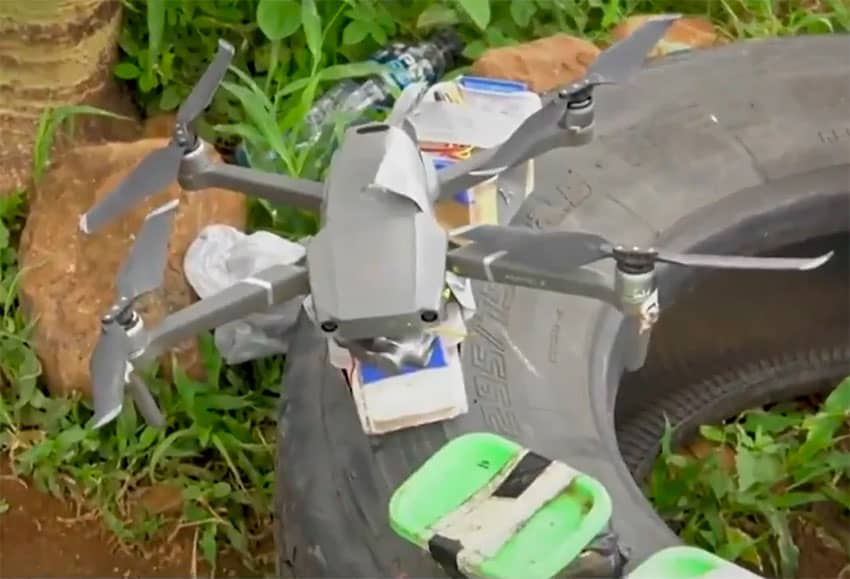
Jalisco cartel adopts new tactic: drones armed with C-4 explosive

More evidence has surfaced to indicate the Jalisco New Generation Cartel (CJNG) is using drones armed with C4 explosives to attack its enemies.

A citizens’ militia group in Tepalcatepec, Michoacán, reports finding two drones inside an armored car that cartel hitmen had abandoned after an attempted raid on the city, which borders Jalisco, on July 25. 

The C4 was packed with ball bearings to serve as shrapnel in Tupperware-like containers that were equipped with a remote detonation system and duct-taped to the drones, militia members explained. The drones were found in a cardboard box that was soaked in blood, indicating to the militia members that whoever was intending to fly the drones was injured before they could be launched. 

The new tactic represents the cartel’s determination to wrest control of the western Michoacán municipality from the self-defense militia and an evolution of their air attack strategy. In April, the cartel used small planes to drop explosives on Tepalcatepec, but after authorities increased aerial surveillance in the region the CJNG opted for drones, which cannot be detected on radar. 

Militia members say that loud explosions have been heard across the municipality, but no one thus far has been injured in a drone attack. They believe the cartel has not yet learned how to fly and detonate them with precision.

In late April, the Attorney General’s Office reported that drones bearing C4 that were to be used by the CJNG to attack rival members of Santa Rosa de Lima Cartel in Guanajuato were discovered in Puebla. A search of three locations revealed three drones, two controllers, C4, gunpowder, tannerite, seven cell phones, 53 SIM cards, three radios, circuit boards, wiring, two guns and ammunition, although no arrests were made.

The army also uses drones to combat organized crime, and they played a factor in the capture and arrest of Santa Rosa de Lima leader Antonio “El Marro” Yépez Ortiz earlier this month after a fleet of drones armed with high-resolution cameras helped locate and monitor his movements.

Source: El Universal (sp), Infobae (sp), La Silla Rota (sp), Municipios Puebla (sp)

Have something to say? Paid Subscribers get all access to make & read comments.
Manzanillo, Colima, México, 13 de marzo de 2026. La doctora Claudia Sheinbaum Pardo, presidenta Constitucional de los Estados Unidos Mexicanos en conferencia de prensa matutina, “Conferencia del Pueblo” desde Colima. La acompañan Indira Vizcaíno Silva, gobernadora Constitucional del Estado de Colima; Omar García Harfuch, secretario de Seguridad y Protección Ciudadana (SSPC); Raymundo Pedro Morales Ángeles, secretario de Marina (Semar); Bulmaro Juárez Pérez, divulgador de lenguas originarias, presentador de la sección “Suave Patria”; Ricardo Trevilla Trejo, secretario de la Defensa Nacional (Sedena); Jesús Antonio Esteva Medina, secretario de Infraestructura, Comunicaciones y Transportes; Bryant Alejandro García Ramírez, fiscal general del Estado de Colima; Fabián Ricardo Gómez Calcáneo; Rocío Bárcena Molina, subsecretaria de Desarrollo Democrático, Participación Social y Asuntos Religiosos de la Secretaría de Gobernación; Efraín Morales López, director general de la Comisión Nacional del Agua (Conagua); Marcela Figueroa Franco, secretaria ejecutiva del Sistema Nacional de Seguridad Pública (SESNSP) y Guillermo Briseño Lobera, comandante de la Guardia Nacional (GN). Foto: Saúl López / Presidencia

Mexico’s week in review: Congress deals Sheinbaum her first legislative defeat

0
The week of March 9 in Mexico was marked by standoffs between allies in Congress and adversaries at the airport. Here's what you missed.
A soldier displays seized handguns

The US and Mexico, growing together and growing apart: A perspective from our CEO

0
From a historic drop in homicides to opposite bets on electric vehicles, Mexico News Daily's CEO breaks down where the U.S. and Mexico are converging — and where they're not.
Veracruz Gov.

Veracruz governor blames private vessel for 200-kilometer Gulf Coast oil spill

1
The spill, which has spread to over 200 kilometers of Mexico's Gulf Coast beaches, has been traced to a private oil tanker off the coast of Tabasco.
BETA Version - Powered by Perplexity